

Achieving the perfect blonde is one of the most celebrated milestones in the hairdressing chair. Whether it is a shimmering platinum, a soft baby blonde, or a multidimensional balayage, stepping out of the salon with a clean, cool, and radiant tone is an incomparable feeling.
Yet, for both stylists and clients, maintaining that pristine shade presents an ongoing challenge. Within a matter of weeks, cool blonde locks can lose their lustre and drift into warm, brassy, or distinctly yellow territory.
Understanding why blonde hair turns yellow is the first step in stopping unwanted warmth in its tracks. In this comprehensive guide, we explore the science behind colour oxidation, the everyday environmental culprits that compromise blonde tones, and the targeted professional routines required to keep blonde hair bright, healthy, and effortlessly luminous.
Short answer: Blonde turns yellow because lifting removes the dark pigment first and leaves the warm underlying pigment behind, and because oxidation, hard water, heat and UV keep pushing it warmer afterwards. It is a maintenance problem as much as a technical one. The manufacturer’s answer runs on two levels. In the salon, the Ice Blonde shampoo and mask neutralise on a timer, two to five minutes for the shampoo and five to ten for the mask, with longer meaning cooler. At home, Anti-Yellow Shampoo Plus goes on once or twice a week, carrying black pearl and blueberry pigments plus silk protein so it conditions while it tones. The step most salons skip is the last one: a biphasic anti-yellow spray applied after any lightening service, left in, as the final move before drying, which is exactly where the warmth otherwise creeps back in within the first fortnight.
What the manufacturer specifies for keeping blonde cool:
| Product | How often | Leave on | Note |
|---|---|---|---|
| Anti-Yellow Shampoo Plus | 1 to 2 times a week | A few minutes | Black pearl and blueberry pigments |
| Color Drops Mask, No Yellow | As needed | 20 min salon, 10 min at home | Manufacturer pairs it with the shampoo |
| Biphasic Anti-Yellow Spray | After any lightening | Leave in | Final step, do not rinse |
| Step | Product | Leave on | What it does |
|---|---|---|---|
| 1 | Ice Blonde Black Bleaching Cream | 60 to 80 min | Lifts and counteracts warmth |
| 2 | Ice Blonde Treatment Shampoo | 2 to 5 min | Neutralises, time sets intensity |
| 3 | Ice Blonde Treatment Mask | 5 to 10 min | Neutralises and nourishes |
The Science: Why Does Blonde Hair Turn Yellow?
Blonde hair turning yellow is not an accident—it is a natural chemical and structural reality of lightened hair. To understand why yellowing happens, we must look at hair anatomy, natural pigmentation, and external interactions.
1. Underlying Natural Pigments
Natural hair contains two main types of melanin: eumelanin (which produces dark brown and black tones) and pheomelanin (which produces red and yellow tones). During the lightening or bleaching process, the dark eumelanin is lifted first.
Pheomelanin, however, is much smaller, denser, and significantly more stubborn to break down. Even when hair is lifted to a pale level 9 or 10, a baseline of warm, pale yellow undertone remains. In the salon, a colourist applies a cool-toned gloss or toner to neutralise this raw warmth. As the salon toner gradually fades over successive washes, that natural, underlying yellow pigment re-emerges.
2. Atmospheric and Chemical Oxidation
Lightening hair requires opening the outer cuticle to disperse melanin within the cortex. This process leaves the hair shaft more porous and vulnerable to oxidation.
Oxidation occurs when oxygen molecules in the air react with the chemical bonds in your hair colour. Much like a sliced apple turns brown when exposed to air, lightened hair oxidises when exposed to oxygen, light, and heat, shifting the hair towards warmer, yellower spectrums.
3. Tap Water and Mineral Build-Up
The water running from your shower head can dramatically impact your blonde tone. Hard water contains high concentrations of dissolved minerals such as calcium, magnesium, copper, and iron.
These microscopic mineral deposits cling to porous blonde hair. Iron, in particular, oxidises quickly, imparting an unwanted rusty or golden-yellow tint, while copper can react with lighteners to cause dull, murky discolouration.
4. Thermal Damage from Heat Styling
Excessive heat is one of the quickest ways to scorch blonde hair. High temperatures from hair dryers, straighteners, and curling irons can burn the delicate proteins in the hair and melt salon toners. This thermal stress causes the hair to yellow almost instantly, creating permanent heat-induced brassiness that cannot be washed away.
5. UV Radiation and Sun Exposure
Ultraviolet (UV) light breaks down the structural keratin bonds and oxidises artificial colour molecules. When UV rays penetrate the hair cuticle, they degrade the delicate violet and ash pigments deposited during your toner service, exposing the warm underlying tones beneath.
6. Environmental Pollutants and Swimming Pools
Chlorine in swimming pools and salt in sea water strip the hair of its protective lipid layer, increasing porosity and causing severe discolouration. When chlorine binds to trace metals present in water, it leaves blonde hair looking dull, straw-like, and brassy. Urban pollution and airborne particles also settle onto the hair shaft, creating a yellowish, dingy film.
Colour Theory: How to Neutralise Yellow Tones
To counteract yellow tones effectively, colourists rely on basic colour theory. Looking at the traditional colour wheel, colours directly opposite each other cancel one another out.
- Opposite to Orange: Blue (neutralises copper and orange brassiness)
- Opposite to Red: Green (neutralises red warmth)
- Opposite to Yellow: Violet / Purple (neutralises pale yellow and golden tones)
Because lightened blonde hair predominantly reveals yellow undertones as it oxidises, violet-pigmented professional products are the gold standard for restoring balance. When calibrated correctly, purple pigments visually cancel out warm reflections without staining the hair or making it appear muddy or over-toned.
A Professional Strategy to Manage and Prevent Yellow Tones
Managing blonde hair requires a two-pronged strategy: active neutralisation of warm tones and preventative structural care to preserve hair health.
Here is how hairdressers and consumers can build a dependable blonde-care ritual using premium Italian hair formulations.
Step 1: Targeted Anti-Yellow Cleansing
A regular shampoo will cleanse the scalp, but it will not correct colour shift. Incorporating a dedicated violet shampoo neutralises yellow undertones while refreshing the hair’s radiance.
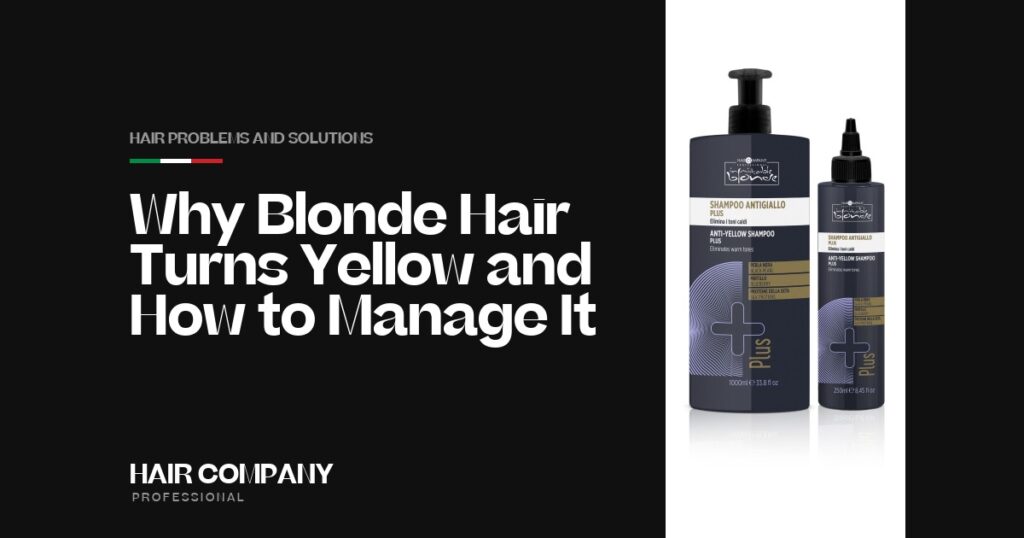
For daily or weekly at-home maintenance, ANTI-YELLOW SHAMPOO PLUS 250ML (£14.45) provides an optimal balance of direct purple pigments and nourishing care. Formulated specifically to eliminate warm and yellow tones from blonde hair, it prevents the hair shaft from yellowing between salon visits.
Enriched with Black Pearl and Hydrolysed Silk Proteins, this formula strengthens weakened hair fibres from within, while Blueberry Fruit Extract provides potent antioxidant protection to shield lightened hair from free-radical oxidation.
For busy salons and professional backwash stations, ANTI-YELLOW SHAMPOO PLUS 1000ML (£28.49) delivers the same high-performance neutralising action in a professional-sized bottle. It allows stylists to immediately tone after lightening services, cleanse brassy extensions, and prep the hair canvas for precision toning.
Step 2: Instant Reconstruction and Leave-In Tone Correction
Lightened hair is naturally prone to moisture loss, porosity, and breakage. Rinsing out a purple shampoo is only half the battle; locking in moisture and maintaining an anti-yellow barrier throughout the day is essential.
The BIPHASIC ANTI-YELLOW RECONSTRUCTION SPRAY (£25.08) is an essential leave-in treatment for any cool-blonde routine. This dual-phase spray combines:
* A pigmented phase: Instantly counteracts and neutralises yellow tones on contact without requiring a rinse.
* A restorative care phase: Packed with Hydrolysed Silk, Seaweed (Fucus Vesiculosus) Extract, Pearl Extract, and Panthenol, it seals the cuticle, detangles effortlessly, and reconstructs compromised hair fibres after bleaching treatments.
Simply shake to blend the two phases, spray evenly through towel-dried hair, and comb through before styling. It acts as an immediate brightening veil while offering thermal and mechanical protection.
Step 3: Clarifying and Protecting Against Summer and Water Aggressors
When spending time outdoors, travelling, or frequenting the pool and gym, standard violet shampoos must be paired with active clarifying and protective care.
The SEA BREEZE HYDRATING SHOWER GEL AND SHAMPOO 250ML (£13.60) is a versatile 2-in-1 formula designed to eliminate chlorine, salt, and mineral residues after swimming or sun exposure.
By purging harsh chemical deposits before they have the chance to oxidise and turn hair yellow, it safeguards your blonde clarity. It is formulated with Beta Carotene for high-potency antioxidant defence, Polynesian Beauty Oil to deeply rehydrate sun-parched strands, and Jasmine Extract to condition the hair shaft and leave a refreshing scent.
Best Practices for Stylists and Clients to Keep Blondes Bright
Beyond using the right professional products, adopting smart hair habits will significantly extend the lifespan of cool blonde tones:
- Lower Your Styling Temperatures: Keep heated tools below 180°C. High heat singes the lightened cuticle and destroys salon-applied toners instantly.
- Avoid Over-Toning: Do not use intense purple shampoos for every single wash. Alternate your anti-yellow routine with hydrating or colour-safe shampoos to prevent cool pigment build-up, which can make blonde hair look dark or grey.
- Rinse with Lukewarm or Cool Water: Hot water opens the hair cuticle, accelerating toner fade and mineral absorption. Finishing your hair wash with a cool rinse seals the cuticle and boosts mirror-like shine.
- Install a Shower Filter: If you reside in an area with hard water, a filtered shower head will drastically reduce chlorine and heavy mineral deposits from reaching your hair.
- Schedule Regular In-Salon Glossing: While at-home care manages colour between appointments, visiting your stylist every 4 to 6 weeks for a fresh professional gloss keeps the hair sealed, healthy, and perfectly toned.
Summary: Maintain Your Dream Blonde with Hair Company UK
Blonde hair turns yellow due to a combination of natural underlying warm pigments, toner fade, heat damage, hard water minerals, and environmental oxidation. While brassiness is a natural occurrence, it is entirely manageable with the right scientific approach.
By incorporating targeted anti-yellow solutions—such as ANTI-YELLOW SHAMPOO PLUS 250ML (£14.45), the professional-sized ANTI-YELLOW SHAMPOO PLUS 1000ML (£28.49), the reconstructive BIPHASIC ANTI-YELLOW RECONSTRUCTION SPRAY (£25.08), and the detoxifying SEA BREEZE HYDRATING SHOWER GEL AND SHAMPOO 250ML (£13.60)—stylists and clients alike can protect their colour investment and enjoy luminous, healthy, and perfectly balanced blonde hair every day.
Frequently Asked Questions
Quick Navigation:
- Why does blonde hair turn yellow so quickly after leaving the salon?
- How often should I use an anti-yellow purple shampoo?
- Can heat styling tools cause blonde hair to go yellow?
- What is the difference between an anti-yellow shampoo and a leave-in anti-yellow spray?
- How does hard water affect blonde hair colour?
- Does chlorine turn blonde hair green or yellow?