

Achieving the perfect clean, luminous blonde is the hallmark of professional hairdressing. However, maintaining that immaculate hue against inevitable warmth is an ongoing challenge. Whether you are a salon stylist perfecting a client’s platinum finish or a blonde enthusiast preserving your shade between appointments, learning how to neutralise yellow tones in blonde hair is essential.
Unwanted brassiness compromises the brightness and clarity of lightened hair. Banishing these warm undertones requires a firm grasp of hair biology, colour theory, and targeted salon-grade formulations.
Short answer: Yellow in lifted blonde is unoxidised warm pigment left in the cortex, and it is neutralised with violet and blue, not with more lifting. The Ice Blonde system does it in three steps and the time on each step is the control you have. The black bleaching cream carries bamboo charcoal to counteract warmth while it lifts. The treatment shampoo is left on two to five minutes depending on how cool you want the result, and the mask five to ten minutes for the same reason. Longer means cooler, and that is the manufacturer’s own instruction rather than a rule of thumb. For maintenance at home, Anti-Yellow Shampoo Plus is used once or twice a week, and the producer explicitly pairs it with the No Yellow pigment from the Color Drops range to deepen the effect without another salon visit.
The three-step in-salon system, then what keeps it that way at home:
| Step | Product | Leave on | What it does |
|---|---|---|---|
| 1 | Ice Blonde Black Bleaching Cream | 60 to 80 min | Lifts and counteracts warmth |
| 2 | Ice Blonde Treatment Shampoo | 2 to 5 min | Neutralises, time sets intensity |
| 3 | Ice Blonde Treatment Mask | 5 to 10 min | Neutralises and nourishes |
| Product | How often | Leave on | Note |
|---|---|---|---|
| Anti-Yellow Shampoo Plus | 1 to 2 times a week | A few minutes | Black pearl and blueberry pigments |
| Color Drops Mask, No Yellow | As needed | 20 min salon, 10 min at home | Manufacturer pairs it with the shampoo |
| Biphasic Anti-Yellow Spray | After any lightening | Leave in | Final step, do not rinse |
Why Blonde Hair Turns Yellow: The Science of Brassiness
To effectively eliminate warm tones, one must first understand why they appear. When natural hair is lightened, bleach or high-lift tint breaks down melanin—the pigment responsible for natural hair colour.
Melanin consists of two primary types:
* Eumelanin: Responsible for dark brown and black tones.
* Pheomelanin: Responsible for red, copper, and yellow undertones.
During the lifting process, eumelanin disperses rapidly, while the microscopic, stubborn granules of pheomelanin linger. Even when hair is lifted to a clean pale yellow (Level 9 or Level 10), the underlying raw pigment retains natural warmth.
External Factors Accelerating Yellowing
Beyond the lifting process, post-colour environmental exposure quickly degrades cool pigments:
* UV Light & Sun Exposure: Ultraviolet rays oxidise hair proteins and strip artificial cool toner molecules.
* Hard Water & Mineral Buildup: Calcium, magnesium, copper, and iron in tap water attach to high-porosity hair, imparting an unsightly dingy yellow cast.
* Thermal Styling: Excessive heat from straighteners and dryers breaks down toners and scorches the hair’s outer cuticle, revealing underlying warmth.
* Pollution & Free Radicals: Atmospheric particles oxidise exposed hair shafts, dulling blonde tones.
The Colour Wheel: How Violet Neutralises Yellow
Neutralising warm tones relies on the classic principles of subtractive colour theory.
On the universal colour wheel, colours situated directly opposite one another are complementary; when combined, they cancel each other out optically.
* Violet sits directly opposite Yellow.
* Blue sits directly opposite Orange.
* Green sits directly opposite Red.
To neutralise yellow tones in blonde hair, you must introduce micro-pigments derived from the violet spectrum. When calibrated properly, violet pigments deposit onto the hair shaft, optically counteracting yellow wavelengths and reflecting a neutral, bright, cool light.
Professional Step-by-Step Protocol to Neutralise Yellow Tones
Eliminating warmth requires a systematic approach that balances pigment deposition with deep structural nourishment. Bleached hair has elevated cuticles and increased porosity, meaning colour correction must always protect hair integrity.
“
[ Assess Base Level & Porosity ]

               ↓

[ Cleanse & Deposit Pigment (Shampoo) ]

               ↓

[ Seal Cuticle & Reconstruct (Leave-In) ]

               ↓

[ Low-Heat Styling & Thermal Defence ]
Step 1: Base Cleansing and Micro-Pigment Deposition
For all-over pale yellow tones, regular pigmented cleansing is the first line of defence. Standard supermarket purple shampoos frequently rely on heavy synthetic dyes and drying sulphates that strip fragile blonde strands. Professional solutions utilise balanced surfactants paired with conditioning agents.
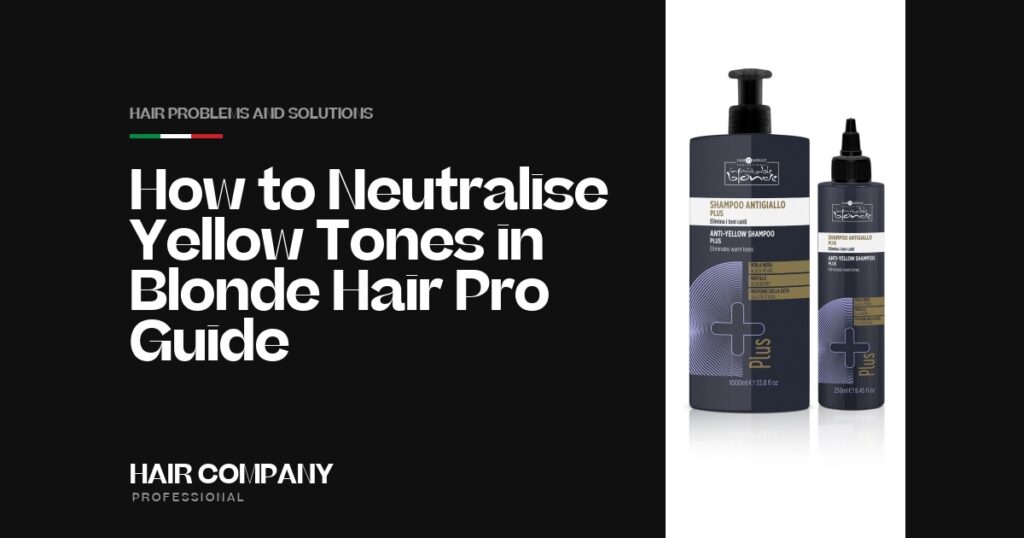
For general yellow elimination, salon stylists rely on ANTI-YELLOW SHAMPOO PLUS 250ML (£14.45) for client retail, or the cost-effective backwash-sized ANTI-YELLOW SHAMPOO PLUS 1000ML (£28.49).
This specialised Italian formula targets stubborn yellow undertones while simultaneously conditioning the hair. Enriched with Black Pearl and Hydrolysed Silk Proteins, it reinforces delicate hair fibres, while Blueberry Fruit Extract delivers antioxidant protection against free-radical oxidation.
How to use:
1. Wet the hair thoroughly with warm water to open the cuticles.
2. Apply evenly through the mid-lengths and ends before working toward the roots.
3. Emulsify and allow the violet pigments to process for 2 to 5 minutes depending on the level of warmth.
4. Rinse thoroughly until water runs completely clear.
Step 2: Formulating for Ultra-Cool and Nordic Blondes
When clients demand an ultra-cool, silver, or Nordic finish, standard violet shampoos may not provide sufficient depth. An advanced ash-toning cleanser is required.
The ICE BLONDE TREATMENT SHAMPOO 250ML (£14.49) is engineered specifically for grey, silver, and ice-blonde tones. Formulated with Charcoal Powder and concentrated cool pigments, it absorbs impurities, eliminates warm hues, and locks in pristine cool undertones without leaving muddy residue.
Step 3: Reconstruction and Instant Leave-In Toning
Applying in-shower pigment is only half the battle. Porous blonde hair loses moisture rapidly, leading to rough cuticles that release cool toners prematurely. A leave-in treatment seals the cuticle layer while providing continuous colour correction.
The BIPHASIC ANTI-YELLOW RECONSTRUCTION SPRAY (£25.08) offers an essential multi-action post-bleach treatment. This advanced two-phase formula delivers immediate dual benefits:
1. The Upper Phase: Instantly deposits sheer violet pigments to neutralise yellow tones on contact while smoothing the external cuticle for brilliant shine.
2. The Lower Phase: Uses Hydrolysed Silk, Panthenol, and Seaweed Extract to penetrate the cortex, reconstructing damaged keratin bonds and restoring essential hydration.
How to use:
1. Shake vigorously to blend the two active phases.
2. Mist evenly over clean, towel-dried hair from mid-lengths to ends.
3. Comb through with a wide-tooth comb for uniform distribution.
4. Do not rinse. Proceed to style as desired.
Best Practices: Avoiding the Common Pitfalls of Toning Blonde Hair
While violet pigments are remarkably effective, improper application can cause undesirable results. Follow these expert guidelines:
1. Avoid Porosity Overload (The “Purple End” Syndrome)
The ends of long blonde hair are naturally more porous and damaged than the roots. If left untreated, porous hair absorbs purple pigment rapidly, turning violet or dull grey.
* The Solution: Apply pigmented shampoos first to the warmer root and mid-lengths. Work the product through the porous ends only during the final 60 seconds of processing.
2. Do Not Overuse Pigmented Shampoos
Using an anti-yellow shampoo for every single wash causes excessive pigment buildup, making blonde hair appear darker and lifeless.
* The Solution: Recommend alternating ANTI-YELLOW SHAMPOO PLUS 250ML (£14.45) with a dedicated moisture or bond-rebuilding shampoo once or twice per week.
3. Manage Heat Styling Temperatures
High temperatures immediately yellow lightened hair by singeing delicate proteins. Always keep styling tools under 185°C and ensure a protective barrier, such as the BIPHASIC ANTI-YELLOW RECONSTRUCTION SPRAY (£25.08), is applied before blow-drying or straightening.
Summary of Targeted Anti-Yellow Solutions
| Product | Best For | Key Active Ingredients | Key Benefit |
| :— | :— | :— | :— |
| ANTI-YELLOW SHAMPOO PLUS 250ML (£14.45) | Routine home anti-brass maintenance | Blueberry Extract, Black Pearl, Silk Protein | Gently neutralises yellow while strengthening hair shafts |
| ANTI-YELLOW SHAMPOO PLUS 1000ML (£28.49) | Salon backwash colour-correcting | Blueberry Extract, Hydrolysed Pea, Silk Protein | Salon-sized bottle for professional backwash toning |
| ICE BLONDE TREATMENT SHAMPOO 250ML (£14.49) | Platinum, silver, and ice-blonde tones | Charcoal Powder, Specialised Cool Dyes | Removes impurities and maintains cool ash tones |
| BIPHASIC ANTI-YELLOW RECONSTRUCTION SPRAY (£25.08) | Post-bleach leave-in care & instant toning | Seaweed Extract, Pearl Extract, Panthenol | Reconstructs bonds and deposits instant anti-yellow veil |
Mastering the balance between micro-pigment deposition and structural hair reconstruction ensures blonde hair remains luminous, healthy, and completely free from brassiness.
Frequently Asked Questions
Quick Navigation:
- Why does blonde hair turn yellow so quickly after bleaching?
- How often should I use an anti-yellow shampoo?
- Can anti-yellow products dry out or damage blonde hair?
- What is the difference between an anti-yellow shampoo and an ice blonde shampoo?
- How do salon professionals avoid purple or muddy patches on porous ends?
- Should anti-yellow leave-in spray be used on wet or dry hair?