

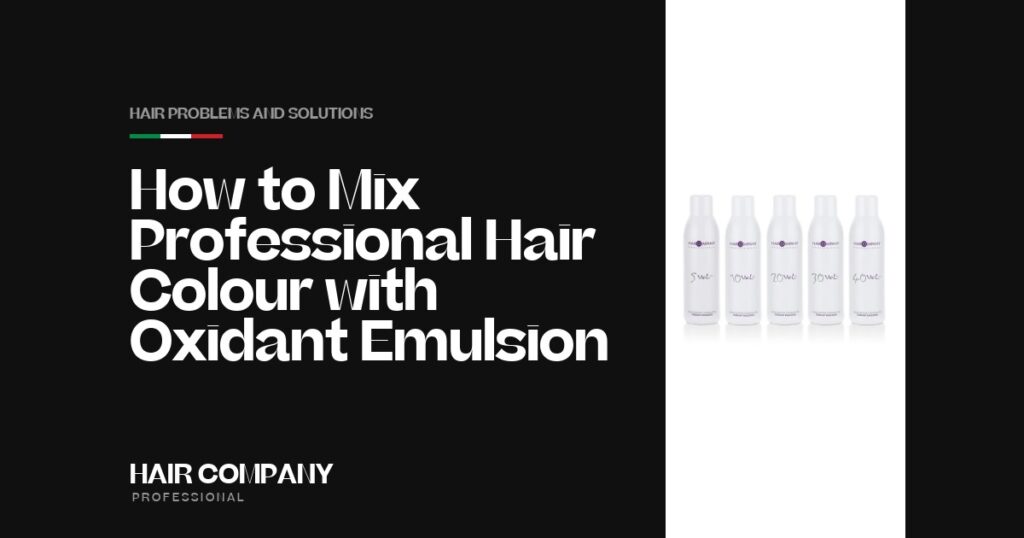
Achieving exceptional, salon-grade hair colour requires far more than simply selecting an appealing shade from a swatch chart. Hair colouring is an exact science—a chemical reaction governed by precise measurements, compatible formulations, and expert technique. At the centre of this process lies the critical relationship between the colouring cream and the oxidant emulsion.
Whether you are an experienced salon professional seeking to refine your technical precision or an ambitious enthusiast wanting professional-standard results at home, learning how to mix professional hair colour with oxidant emulsion correctly is the single most important skill you can master.
In this comprehensive guide, we explore the science of oxidation, break down the standard mixing ratios, guide you in choosing the correct developer volume, and provide a step-by-step method to achieve flawless, luminous, and long-lasting colour every time.
Short answer: Mixing ratio is set by the colour line, not by preference, and each Hair Company line has its own. Colouring Cream Classic and Color Oil both run at 1:1.5. Super-lighteners and every bleach run at 1:2. The 10-minute cream is the exception at 1:1. Oxidant emulsions come in 5, 10, 20, 30 and 40 Vol and are formulated to work with Inimitable colour, Made for Men and the Inimitable Blonde bleaches. Weigh, never eyeball: an inaccurate ratio changes the pH of the mixture, and pH decides whether the cuticle opens enough to deposit evenly. Use a non-metallic bowl. If the mixture is too fluid for the technique, 3D Color Mixer thickens it at roughly 5 grams per mix without weakening lift, which lets you isolate single sections without foil. Keep its lid clean, because it hardens on contact with air.
The official dilution table, then the working figures for the two main permanent lines:
| Product | Mixing ratio |
|---|---|
| Colouring Cream Classic | 1:1.5 |
| Color Oil Ammonia Free | 1:1.5 |
| Super-lighteners (12.x) | 1:2 |
| Bleaches | 1:2 |
| Result you want | Developer | Time | Ratio |
|---|---|---|---|
| Toning and neutralising | 5 to 10 Vol (1.5 to 3%) | On sight | 1:1 to 1:1.5 |
| Grey coverage, lift 1 to 2 levels | 20 Vol (6%) | 35 min | 1:1.5 |
| Grey coverage, lift 2 to 3 levels | 30 Vol (9%) | 40 min | 1:1.5 |
| Super-lighteners only | 40 Vol (12%) | 45 min | 1:2 |
| Result you want | Developer | Ratio | Time |
|---|---|---|---|
| Toning and neutralising | 5 Vol (1.5%) | 1:1 to 1:2 | 20 min |
| Tone on tone | 10 Vol (3%) | 1:1 to 1:1.5 | 20 min |
| Coverage, lift 1 level | 20 Vol (6%) | 1:1.5 | 35 min |
| Coverage, lift 2 levels | 30 Vol (9%) | 1:1.5 | 40 min |
The Science: What is Oxidant Emulsion and Why Does It Matter?
Permanent and demi-permanent hair colours rely on oxidation to develop their pigments inside the hair shaft. Hair colouring cream contains uncoloured dye precursors (micro-pigments) and an alkalising agent (such as ammonia or MEA). However, these pigments remain dormant until they are mixed with an oxidising agent—specifically hydrogen peroxide ($H_2O_2$).
When you combine hair colour cream with an oxidant:
1. The cuticle opens: The alkalising agent gently swells the hair cuticle, allowing the ingredients to penetrate deep into the cortex.
2. Natural melanin lightens: The oxidant emulsion oxidises and lightens a portion of the hair’s natural pigment (melanin) to make room for the new tone.
3. Artificial pigments develop and expand: The hydrogen peroxide reacts with the dye precursors, causing them to couple and expand into full colour molecules. Because these molecules become larger, they become trapped inside the hair cortex, ensuring long-lasting durability and tone.
Using a high-calibre, stabilised developer is essential. Substandard or generic developers can cause inconsistent lifting, uneven tonal deposit, and unnecessary cuticle damage. For salon efficiency, salon owners typically stock OXIDANT EMULSION 1000ML (£9.99), which features a rich, stabilised emulsion formula that ensures uniform distribution. For smaller applications, bespoke formulations, or mobile stylists, OXIDANT EMULSION 150ML (£4.49) provides the same Italian-crafted precision in a compact format.
Understanding Professional Hair Colour Mixing Ratios
The mixing ratio determines the exact balance between the colour pigment concentration and the lifting power of the developer. Always check the manufacturer’s technical manual, but most professional Italian colour systems operate across three primary ratios:
“
+---------------+-----------------------------+------------------------------------+

| Mixing Ratio  | Typical Application         | Example Measurement                |

+---------------+-----------------------------+------------------------------------+

| 1:1           | Grey coverage, tonal depth  | 50g Colour Cream + 50g Oxidant     |

| 1:1.5         | Standard permanent colour   | 50g Colour Cream + 75g Oxidant     |

| 1:2           | High-lift blondes & toners  | 50g Colour Cream + 100g Oxidant    |

+---------------+-----------------------------+------------------------------------+
1. The 1:1 Ratio (Equal Parts)
This ratio provides the highest concentration of pigment and maximum deposit. It is standard for:
* Resistant grey hair coverage.
* Tone-on-tone darkening.
* Creating deep, saturated fashion shades.
2. The 1:1.5 Ratio (Standard Formulation)
Favoured by premium Italian colour systems such as Inimitable Color, a 1:1.5 ratio provides the ideal harmony between cosmetic conditioning, tonal deposit, and clear lifting action. It is commonly used for:
* Regular root retouching and virgin application.
* Balanced grey blending.
* Standard lifting (1–3 levels).
3. The 1:2 Ratio (Double Oxidant)
A double measure of oxidant dilutes the pigment concentration while maximising the lifting power of the peroxide. This ratio is strictly reserved for:
* High-lift blonde series (levels 11 and 12).
* Translucent pastel toning on pre-lightened hair.
* Specialist lightening pastes and bleaches.
If you are setting up your workstation or refreshing your salon’s primary dispensary, investing in the Colouring Starter Kit – Professional Colour System (£129.99) guarantees you have the complete portfolio of shades and professional developers required to master all three mixing ratios.
Choosing the Correct Developer Strength (Volume vs Percentage)
Selecting the right strength of oxidant emulsion is just as vital as choosing the correct colour tube. Developer strength is measured in Volumes (Vol.) in the UK and USA, and Percentage (%) in continental Europe.
Here is how to choose the right strength using a professional range such as OXIDANT EMULSION 1000ML (£9.99) or OXIDANT EMULSION 150ML (£4.49), available in five calibrated strengths:
5 Vol. (1.5%) – Tone-on-Tone & Glossing
- Lifting Power: 0 levels (deposit only).
- Best Used For: Refreshing faded ends, pastel toning over bleached hair, and glossing without lifting the natural base.
10 Vol. (3%) – Deposit & Minimal Lift
- Lifting Power: 0–1 level of lift.
- Best Used For: Darkening the hair, matching the existing base level, or colouring fine, porous hair where lift is not required.
20 Vol. (6%) – The Industry Standard
- Lifting Power: 1–2 levels of lift.
- Best Used For: Standard permanent colouring, achieving 100% grey hair coverage, and lifting 1 to 2 shades lighter than the natural starting base.
30 Vol. (9%) – Extra Lift & Vibrant Tones
- Lifting Power: 2–3 levels of lift.
- Best Used For: Bright fashion colours (coppers, vibrant reds) and lifting dark natural bases to lighter target shades.
40 Vol. (12%) – Maximum Lift
- Lifting Power: 3–4 levels of lift (up to 5 levels with high-lift lines).
- Best Used For: High-lift blondes on strong, healthy hair. Note: 40 Vol. should never be applied directly onto an irritated scalp.*
Step-by-Step: How to Mix Hair Colour Like a Professional
Precision is the hallmark of every master colourist. Follow this step-by-step protocol to mix your formulas cleanly and effectively.
Step 1: Prepare Your Equipment
Never use metal tools when working with permanent hair colours or oxidants. Metal can cause an adverse catalytic reaction with hydrogen peroxide, oxidising the colour prematurely and creating unpredictable results.
* Use a non-metallic bowl (plastic, glass, or silicone).
* Use a dedicated plastic tint brush or a silicone colour whisk.
* Use an accurate digital salon scale (measuring in 1g increments).
Step 2: Weigh the Colouring Cream First
Place your clean mixing bowl onto the digital scale and press the Tare (zero) button. Squeeze the exact amount of colouring cream required into the bowl.
Expert Tip: Squeezing the cream first prevents splashing and ensures you do not over-pour the liquid emulsion.
Step 3: Add the Oxidant Emulsion
Reset your scale to zero again. Carefully pour the required volume of OXIDANT EMULSION 150ML (£4.49) or OXIDANT EMULSION 1000ML (£9.99) directly over the cream according to your calculated ratio.
Example for a 1:1.5 ratio:
* 40g Colour Cream
* 60g Oxidant Emulsion (40 x 1.5 = 60)
Step 4: Whisk to a Smooth, Homogenous Consistency
Using your tint whisk or brush, vigorously blend the cream and emulsion together. Ensure there are no unmixed lumps of colour cream clinging to the sides or base of the bowl. The final mixture should be a smooth, velvety, cohesive emulsion that adheres effortlessly to the hair strand without dripping.
Step 5: Apply Immediately
The chemical oxidation process begins the exact second the colour cream contacts the hydrogen peroxide. Do not allow mixed colour to sit on your trolley. Apply the mixture to the hair immediately to ensure maximum tonal deposit inside the cortex rather than in the bowl.
Specialised Formulations: Men’s Grey Blending
Formulating colour for male clients requires a distinct approach. Traditional permanent colour can sometimes look overly dense, artificial, or leave an obvious regrowth line that clients dislike.
For discreet, natural-looking results, utilise NATURAL COVER COLOURING CREAM FOR MEN (£5.99). This specialised permanent oxidation colour is specifically engineered to blend grey hair naturally. Depending on the development time and mixing technique, it allows the colourist to achieve anything from a subtle brushed effect (camouflaging 30–50% of greys) to full, discreet coverage without warm, brassy undertones.
5 Common Hair Colour Mixing Mistakes to Avoid
1. Estimating or “Eye-Balling” Ratios: Measuring by eye leads to inconsistent results. Too much developer dilutes the tone and leads to translucent results; too little developer leads to incomplete colour development and scalp irritation.
2. Using the Wrong Developer Brand: Mixing Colour Brand A with Developer Brand B can compromise the result. Professional lines formulate their colour creams with specific pH buffers, viscosity agents, and conditioning polymers designed to pair with their own oxidants.
3. Letting the Mixture Sit: Preparing colour 15 minutes before application wastes the active oxidation phase in the bowl, leading to rapid fading and poor grey coverage.
4. Incorrect Volume Selection for Grey Hair: Attempting to cover resistant grey hair with 10 Vol. or 30 Vol. developer often fails. 20 Vol. (6%) provides the necessary cuticle opening and pigment development required for complete coverage.
5. Incomplete Blending: Rushing the mixing stage leaves pockets of raw colour cream unmixed with peroxide, causing splotchy, uneven colour bands across the hair.
Summary
Mastering the balance between professional colouring cream and oxidant emulsion transforms hair colouring from guesswork into an exact, repeatable craft. By investing in professional tools like the Colouring Starter Kit – Professional Colour System (£129.99), selecting premium stabilised oxidants, and adhering strictly to measured ratios, you guarantee consistent, healthy, and luminous results on every application.
Frequently Asked Questions
Quick Navigation:
- Can I mix different brands of colour cream and oxidant emulsion?
- What happens if I put too much oxidant emulsion in my hair colour mix?
- Should I measure hair colour by weight (grams) or volume (millilitres)?
- Why is my hair colour changing colour in the mixing bowl?
- What is the best oxidant volume for 100% grey hair coverage?
- How long can mixed hair colour sit before it becomes unusable?