

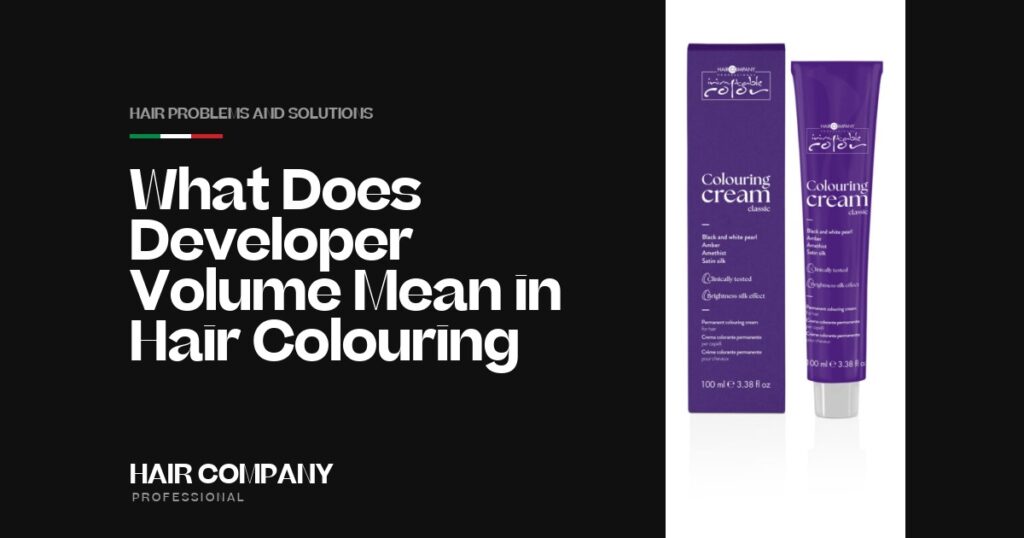
In professional hair colouring, precision is everything. Whether you are formulating a rich Brunette tone, transforming a client into a glowing blonde, or achieving complete grey coverage, the success of your colour formula depends heavily on one essential element: the developer.
Understanding developer volume in hair colouring is fundamental to achieving predictable, radiant, and long-lasting colour results while maintaining hair fibre integrity.
Short answer: Developer volume is the percentage of hydrogen peroxide in the mix, and it decides how far the hair lifts. 5 Vol is 1.5 percent, 10 Vol is 3 percent, 20 Vol is 6 percent, 30 Vol is 9 percent and 40 Vol is 12 percent. On Inimitable Color Classic, 5 to 10 Vol tones and neutralises, 20 Vol covers grey and lifts one to two levels in 35 minutes, and 30 Vol lifts two to three levels in 40 minutes. Both sit at a 1:1.5 ratio. 40 Vol is the one that gets misused: in this range it belongs to the super-lightener series only, mixed at 1:2 for 45 minutes. Reaching for a higher volume to fix poor grey coverage does the opposite, because it lifts the natural hair further while leaving the colourless grey strands under-deposited and warm. Volume controls lift. Pigment choice controls coverage.
Available strengths and what the manufacturer pairs them with:
| Product | Mixing ratio |
|---|---|
| Colouring Cream Classic | 1:1.5 |
| Color Oil Ammonia Free | 1:1.5 |
| Super-lighteners (12.x) | 1:2 |
| Bleaches | 1:2 |
| Result you want | Developer | Time | Ratio |
|---|---|---|---|
| Toning and neutralising | 5 to 10 Vol (1.5 to 3%) | On sight | 1:1 to 1:1.5 |
| Grey coverage, lift 1 to 2 levels | 20 Vol (6%) | 35 min | 1:1.5 |
| Grey coverage, lift 2 to 3 levels | 30 Vol (9%) | 40 min | 1:1.5 |
| Super-lighteners only | 40 Vol (12%) | 45 min | 1:2 |
What Is Hair Developer and How Does It Work?
Hair developer, also known as hydrogen peroxide or oxidant, is an oxidising lotion or cream that activates permanent and demi-permanent hair colours and lighteners.
Without a developer, oxidative hair colour cannot work. The colour cream contains uncoloured pigment precursors (micropigments) and an alkalising agent such as ammonia or ethanolamine. When mixed with developer:
1. The cuticle opens: The alkalising agent gently swells the hair cuticle layer.
2. Natural pigment disperses: The hydrogen peroxide oxidises and lightens a portion of the hair’s natural melanin.
3. Artificial colour develops: The oxygen released by the peroxide oxidises the pigment precursors, coupling them into larger colour molecules trapped inside the hair cortex.
Developer Volume vs Percentage: What Do the Numbers Mean?
In professional salons across the UK and Europe, you will often hear hydrogen peroxide measured in two distinct ways: Volume (Vol) and Percentage (%).
- Volume (Vol): Measures the amount of pure oxygen gas released from one measure of liquid peroxide. For example, 1 litre of 20 Volume developer releases 20 litres of oxygen.
- Percentage (%): Indicates the proportion of pure hydrogen peroxide active within the total liquid or cream formula.
Developer Conversion Chart
| Developer Volume | Peroxide Percentage | Primary Function | Levels of Lift |
| :— | :— | :— | :— |
| 5 – 10 Vol | 1.5% – 3% | Tone-on-tone, deposit-only, glaze, delicate toning | 0 – 1 Level |
| 20 Vol | 6% | Standard permanent colour, 100% grey coverage | 1 – 2 Levels |
| 30 Vol | 9% | Lighter shades, high-lift applications, resistant hair | 2 – 3 Levels |
| 40 Vol | 12% | Maximum lift, high-lift blonde series | 3 – 4 Levels |
Breaking Down Each Developer Strength
Choosing the right developer is the key difference between an intense, glossy result and an unexpected colour shift or unnecessary hair compromise.
10 Volume Developer (3% Peroxide)
Best for: Tone-on-tone colour, refreshing ends, darker shade deposit, and gentle toning on pre-lightened hair.
10 Volume is primarily a deposit-only developer. It produces minimal to no lift of natural melanin, making it the safest choice when you are depositing pigment level-on-level or transitioning hair to a darker shade. It ensures maximum colour saturation without lifting underlying warm brassy tones.
20 Volume Developer (6% Peroxide)
Best for: Standard permanent colouring, 100% grey coverage, and lifting 1 to 2 levels.
Often considered the salon workhorse, 20 Volume developer opens the cuticle sufficiently to allow deep pigment penetration while offering controlled lift.
If you are formulating for clients with resistant silver or white hair, pairing a 20 Volume developer with a rich, Italian-formulated permanent cream like COLOURING CREAM CLASSIC (£9.49) ensures 100% grey hair coverage. Its formula is enriched with Silk Extract, Pearl, Amber, and Amethyst to impart mirror-like shine and silk-like lustre while maintaining low ammonia levels for a gentler service.
30 Volume Developer (9% Peroxide)
Best for: Lifting 2 to 3 levels, enhancing vibrant fashion shades, and working with coarse, resistant hair types.
When you need noticeable lift without resorting immediately to bleach, 30 Volume provides the extra lifting power required to reveal brighter, more intense fashion tones (such as coppers and bright reds) on natural bases.
Caution: 30 Volume exposes underlying warm tones quickly. Always adjust your tonal balance (adding ash, pearl, or violet pigments) to counteract unwanted warmth.
40 Volume Developer (12% Peroxide)
Best for: Maximum lift (3 to 4 levels) with high-lift blonde series on natural bases.
40 Volume is the strongest developer used in professional hair colouring. It releases substantial amounts of oxygen rapidly. It is generally reserved for high-lift blonding formulations on natural, uncoloured hair (levels 6 and higher).
Professional note: 40 Volume should generally not be used with on-scalp bleach, as it can cause significant scalp irritation and cuticle compromise.
How to Choose the Correct Developer: A Step-by-Step Guide
Formulating hair colour requires systematic evaluation. Follow this checklist before dispensing your product:
“
[1. Identify Natural Base Level]

           ↓

[2. Determine Target Shade & Desired Lift]

           ↓

[3. Assess Hair Porosity, Texture & Grey %]

           ↓

[4. Select Ideal Developer Strength (10, 20, 30, or 40 Vol)]
1. Identify the Natural Starting Level
Assess the client’s regrowth or virgin hair level on the standard 1–10 international colour scale.
2. Determine the Target Level and Tone
Calculate how many levels of lift are required:
Same level or darker?* → Choose 10 Vol (3%).
1 to 2 levels lighter or covering grey?* → Choose 20 Vol (6%).
2 to 3 levels lighter?* → Choose 30 Vol (9%).
3 to 4 levels lighter with high-lift colour?* → Choose 40 Vol (12%).
3. Factor in Hair Condition and Porosity
Porous, chemically treated, or fine hair processes faster and absorbs colour more readily. You can often drop down one developer strength (e.g., using 10 Vol instead of 20 Vol) on compromised lengths and ends to avoid over-processing.
For salons and independent stylists looking to standardise their results, starting with a cohesive colour setup such as the Colouring Starter Kit – Professional Colour System (£129.99) delivers consistent, high-grade Italian pigments, reliable oxidation rates, and predictable tone calibration across all base levels.
Common Developer Mistakes and How to Avoid Them
Even experienced colourists encounter formulation traps. Here are the most frequent developer errors:
- Using 30 or 40 Vol to cover grey hair: High-volume developers lift too aggressively and blow out the artificial micropigments needed to fill unpigmented grey hair. The result is often translucent, hollow coverage. Always stick to 20 Vol for grey coverage.
- Under-measuring developer: Inaccurate ratios (guessing or using volume cups instead of a digital scale) alter the pH of the mixture. This leads to patchy colour development and potential hair damage.
- Using high developer on pre-bleached hair: Applying 20 or 30 Vol to tone already lifted, porous hair causes unnecessary cuticle damage and colour fade. Use 5 to 10 Vol for toning.
Post-Colour Care: Protecting the Hair Fibre
Because developer alters the hair’s outer cuticle to deposit pigment into the cortex, post-colour structural care is essential to lock in tonal longevity and maintain hydration.
Recommending an intensive home and salon treatment such as the Hair Care Professional Routine (£129.99) replenishes lost lipids, seals the cuticle, and shields delicate oxidative pigments from rapid wash-out and environmental oxidation.
When styling freshly coloured or chemically treated hair, opt for weightless styling products that protect the cuticle without causing product buildup. The VOLUME UP MOUSSE 250ML (£19.55) is an ideal post-colour styling choice. Enriched with Hyperfermented Fig and Cactus Extract, its lightweight, non-sticky formula instantly adds full body and bounce to fine, long, or curly hair without drying out the coloured strand or weighing it down.
Summary
Developer volume is the engine that drives professional hair colouring. By mastering the balance between peroxide volume, lifting capabilities, and pigment deposition, colourists can unlock complete creative control and achieve shiny, long-lasting, and healthy colour transformations every single time.
Frequently Asked Questions
Quick Navigation:
- Can I use a 40 volume developer to cover stubborn grey hair?
- What happens if I mix two different developer volumes together?
- Is developer volume the same thing as bleach?
- Why doesn't permanent hair colour work without developer?
- Can I use a different brand's developer with my professional colour cream?
- Does higher developer volume always cause more hair damage?