

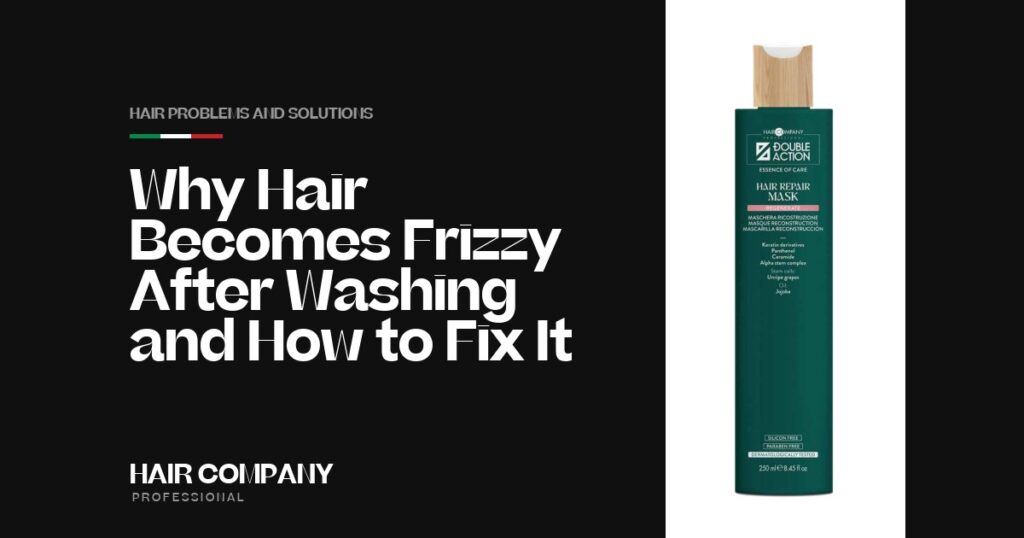
It is one of the most frustrating haircare paradoxes: you spend time cleansing and conditioning your locks, only to step out of the shower and watch them expand into an unruly, flyaway halo. If you have ever wondered why hair becomes frizzy after washing, you are certainly not alone. Both salon clients and professional stylists encounter this common complaint every single day.
Frizz is not merely a styling inconvenience; it is a direct biological signal regarding the structural integrity, moisture levels, and cuticle condition of your hair. When water alters the delicate balance of the hair shaft, strands can swell unevenly, misalign, and lose their natural smoothness.
In this comprehensive guide, we delve into the hair science behind post-wash frizz, analyse the most common shower mistakes, and share expert Italian salon methods to achieve sleek, disciplined, and healthy hair after every wash.
The Science: What Happens to Hair When It Gets Wet?
To understand why hair frizzes post-wash, one must look at the anatomy of the hair fibre. Each strand consists of three layers: the inner medulla, the structural cortex, and the outer protective shield known as the cuticle.
The cuticle is made up of overlapping keratin scales, resembling tiles on a roof or the scales of a pinecone. In healthy, smooth hair, these cuticle scales lie flat against the shaft, locking in essential hydration, reflecting light for brilliant shine, and repelling excess humidity.
The Role of Hydrogen Bonds and Water Absorption
When you wash your hair, water penetrates the outer layer and temporarily breaks the weak hydrogen bonds inside the cortex. These bonds are responsible for your temporary hair shape.
Hair is naturally hygroscopic, meaning it attracts and absorbs water from its environment. If your cuticle layer is compromised, dry, or raised:
1. Water rushes unevenly into the cortex.
2. The hair shaft swells rapidly.
3. The cuticle scales lift and snag against adjacent strands.
4. As the hair dries, hydrogen bonds reform haphazardly, resulting in the irregular, misaligned texture we recognise as frizz.
5 Primary Reasons Your Hair Frizzes After Washing
1. High Hair Porosity and Cuticle Damage
Porosity refers to your hair’s ability to absorb and retain moisture. Chemical treatments (such as bleaching or permanent colouring), heat styling, and environmental weathering strip away the protective F-layer (the natural lipid barrier of the cuticle). This leaves the hair with high porosity. High-porosity hair absorbs water instantly like a sponge, swells rapidly, and loses that hydration just as fast, leading to severe post-wash dehydration and frizz.
2. Washing with Water That Is Far Too Hot
Steamy, scorching showers may feel relaxing, but high water temperatures are detrimental to hair fibres. Excessively hot water strips away the scalp’s natural sebum, dissolves protective lipid coatings, and forces the cuticle layer wide open. Without a cool rinse to encourage the cuticle to contract, the hair fibre remains vulnerable and prone to expansion.
3. Harsh Surfactants and Stripping Cleansers
Using shampoos formulated with aggressive sulphates or an unbalanced pH can disrupt the hair’s natural isoelectric point (around pH 4.5 to 5.5). Alkaline formulations raise the cuticle scales, creating friction between individual strands. When hair lacks conditioning buffers during the cleanse, moisture is stripped out, setting the stage for instant frizz.
4. Mechanical Friction During Towel Drying
The physical way you treat wet hair makes a profound difference. Wet hair is in its most fragile, elastic state. Rubbing hair vigorously with a traditional terry-cloth cotton towel roughs up the delicate cuticle scales, snaps weakened strands, and creates intense static electricity.
5. Ambient Humidity vs Internal Moisture Imbalance
If your hair lacks adequate internal hydration, it will actively seek moisture from the surrounding air. When you step out of a steamy bathroom or into British humidity with under-moisturised hair, your strands instantly absorb airborne water molecules, causing the hair shaft to buckle and frizz.
How to Prevent Post-Wash Frizz: Professional Salon Solutions
Banishing post-wash frizz requires a targeted approach that restores structural keratin, balances moisture, and seals the cuticle layer. Here is how professional Italian formulations can transform your routine.
1. Rebuild and Reconstruct Damaged Cuticles
When frizz stems from chemical damage or extreme porosity, standard surface conditioners are not enough. You must replenish the hair’s internal protein structure.
Incorporating a targeted treatment like the HAIR REPAIR MASK 250ML (£14.49) works wonders for compromised strands. This rich cosmetic emulsion uses an innovative Alpha stem complex to seal split ends, combined with hydrolysed biomimetic keratin that selectively targets and repairs damaged areas along the hair shaft. Infused with panthenol and jojoba (Simmondsia chinensis), it restores the natural lipid layer, ensuring cuticles lie flat and smooth after rinsing.
2. Nourish and Discipline Unruly Textures
For naturally coarse, unruly, or tangle-prone hair, frizz often results from unaligned hair patterns and lack of discipline.
Applying the BALANCE SMOOTHING HAIR MASK (£15.72) tames rebellious lengths effectively. Powered by Fermented Rice Water, this mask delivers vital nutrients and deep hydration, detangling strands effortlessly while smoothing down raised cuticles. It imparts intense shine and softness to mid-lengths and ends, making post-wash combing frictionless and preventing mechanical frizz.
3. Invest in Comprehensive Scalp and Fibre Therapy
A truly resilient hair routine begins at the root. A stressed, unbalanced scalp often leads to compromised hair growth with irregular cuticle formation.
For a complete professional overhaul, the Double Action Set – Scalp Balance & Hair Repair (£129.99) provides a dual-action therapeutic system. By purifying and balancing the scalp micro-environment while systematically reconstructing the hair fibre, this premium set addresses both the root cause of unruly hair and structural surface damage.
(Note for male grooming routines: ensuring skin and hair balance post-shower is equally vital. A gentle, pH-balanced choice like LENITIVE AFTER SHAVE (£12.75) utilizes French Oak and Aloe Vera to soothe sensitive skin post-wash, preventing moisture depletion and irritation across delicate facial skin.)
Step-by-Step Routine for Frizz-Free Hair After Washing
Follow this stylist-approved regime to lock in moisture and keep cuticles smooth from the moment you turn off the tap:
“
[Proper Cleansing: Warm Water] ➔ [Intensive Mask Application] ➔ [Cool Rinse to Seal] ➔ [Microfibre Blotting] ➔ [Leave-In Cuticle Sealant]
1. Lower the Temperature: Wash hair using lukewarm water. Never use scalding water, as it strips natural lipids.
2. Apply Treatments Strategically: After cleansing, gently squeeze out excess water before applying your mask. Distribute HAIR REPAIR MASK 250ML (£14.49) or BALANCE SMOOTHING HAIR MASK (£15.72) evenly through mid-lengths and ends using a wide-tooth comb.
3. Finish with a Cool Rinse: A 15-second rinse with cool water helps constrict the cuticle layer, leaving a smoother surface that reflects light.
4. Blot, Never Rub: Replace your heavy bath towel with a smooth microfibre towel or a soft cotton t-shirt. Gently squeeze and blot the water out of your hair without friction.
5. Lock in Hydration Immediately: Apply your leave-in conditioner or smoothing serum while the hair is still damp to seal the cuticle before moisture can evaporate.
6. Use Heat Protection & Diffuse Correctly: If blow-drying, always use a professional heat protectant. Keep the airflow directed downward along the hair shaft to encourage cuticle closure, or use a diffuser on low heat for natural curls.
Summary: Restoring Harmony to Post-Wash Hair
Understanding why hair becomes frizzy after washing empowers you to treat the underlying cause rather than masking the symptoms. Post-wash frizz is fundamentally a moisture and structural issue: lifted cuticles absorbing uneven moisture from the environment.
By introducing restorative treatments enriched with biomimetic keratin, fermented botanical waters, and pH-balancing agents, you can seal the cuticle layer, retain essential internal hydration, and enjoy sleek, luminous, and manageable results after every wash.
Frequently Asked Questions
Quick Navigation:
- Why does my hair become frizzy immediately as it air-dries?
- Does rinsing with cold water actually reduce post-wash frizz?
- How often should I use a hair repair mask to treat chronic frizz?
- What is the difference between dry hair and frizzy hair?
- Why does my hair feel frizzy even after using conditioner?
- Can an unhealthy scalp cause frizzy hair?