

Taming unruly texture while maintaining bounce and vitality is one of the most sought-after salon outcomes. Curly and wavy hair types possess a delicate, elliptical structure that makes them inherently prone to dehydration, cuticle disruption, and environmental reactivity. When atmospheric humidity fluctuates, porous strands rapidly absorb airborne moisture, swelling the hair shaft and creating unwanted frizz.
To deliver consistent, long-lasting smoothness and defined movement, stylists and haircare enthusiasts must transition from temporary fixes to an intentional, step-by-step regime. Building a dedicated anti frizz salon routine for curly and wavy hair requires a balance of targeted scalp preparation, deep moisture infusion, structural repair, and meticulous finishing techniques powered by premium formulations.
Understanding the Anatomy of Frizz in Textured Hair
Frizz is not merely an aesthetic nuisance; it is a structural symptom of moisture imbalance.
Wavy (Type 2) and curly (Type 3) hair fibres feature an irregular, spiral shape where the protective cuticles naturally lift along the curves of the strand. This anatomical feature makes it difficult for natural sebum produced at the scalp to travel down the hair shaft to lubricate the lengths and ends.
“
+-------------------------------------------------------------------------+

|                        THE FRIZZ FORMATION CYCLE                        |

|                                                                         |

|  [Cuticle Disruption / Porosity]                                       |

|               │                                                         |

|               ▼                                                         |

|  [Internal Moisture Loss & Dehydration]                                |

|               │                                                         |

|               ▼                                                         |

|  [Strands Seek Atmospheric Water / High Humidity]                       |

|               │                                                         |

|               ▼                                                         |

|  [Uneven Hair Shaft Swelling = FRIZZ & LOSS OF DEFINITION]              |

+-------------------------------------------------------------------------+
When dehydrated hair encounters ambient moisture, hydrogen bonds within the cortex temporarily break and reform unevenly, resulting in expansion, flyaways, and a loss of curl pattern definition. A successful anti-frizz salon routine addresses this vulnerability by replenishing internal hydration, fortifying the lipid barrier, and smoothing the outer cuticle layer.
Step 1: The Scalp-First Foundation
Every transformative haircare routine begins at the scalp. Product build-up, excess sebum, and flaking create an unhealthy follicle environment that disrupts natural hair growth and forces styling products to sit on the surface rather than penetrate the cortex.
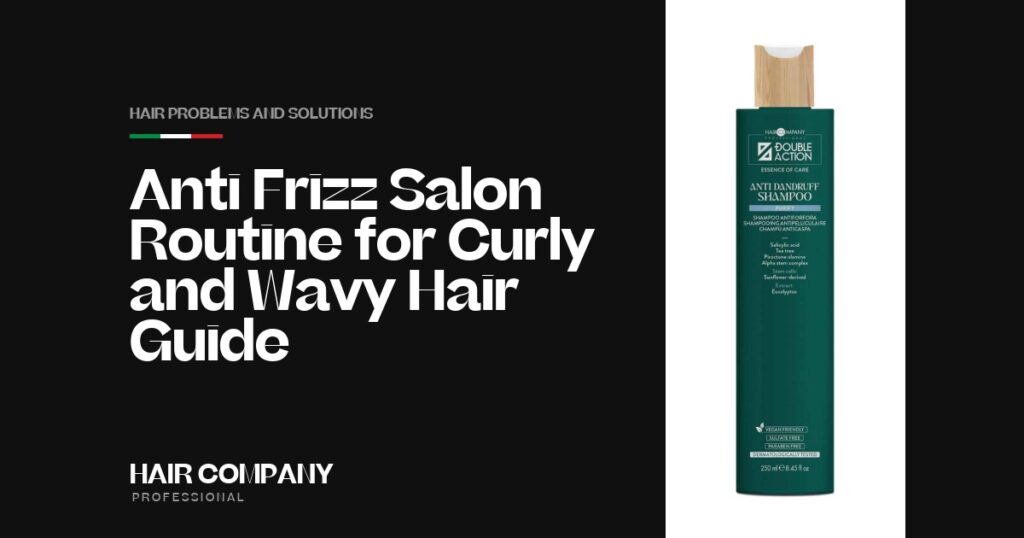
For clients struggling with both scalp sensitivity and unruly texture, a detoxifying yet balanced wash is essential. Incorporating ANTI DANDRUFF SHAMPOO 250ML new (£13.6) into the clarifying stage effectively purifies the root zone. Formulated with Salicylic Acid to gently exfoliate dead cellular debris and Tea Tree Oil to provide natural antimicrobial protection, this specialist wash normalises scalp conditions. Its Alpha Stem Complex supports long-term recovery without stripping the essential moisture that curly hair requires to stay supple.
By clearing follicle congestion and balancing the scalp biome, hair emerges with improved root lift and structural integrity, laying a clean foundation for conditioning treatments.
Step 2: Gentle Cleansing and Replenishing Hydration
Cleansing curly and wavy hair demands a delicate touch. Aggressive surfactants strip the natural lipids needed to seal down the cuticle layer, instantly inviting frizz. Salons must adopt a tailored washing method that protects hair integrity while eliminating environmental impurities, chlorine, and minerals.
When working with hair that has been exposed to environmental aggressors, hard water, or sun exposure, the SEA BREEZE HYDRATING SHOWER GEL AND SHAMPOO 250ML (£13.6) provides an exceptional dual-action cleansing experience. Enriched with nourishing Polynesian Beauty Oil, antioxidant Beta Carotene, and conditioning Jasmine Extract, this multi-benefit formulation cleanses thoroughly while immediately imparting deep moisture.
Best Practices for Cleansing Textured Hair:
- Water Temperature: Always cleanse with lukewarm water; excessively hot water forces cuticles open and accelerates moisture loss.
- Application Technique: Emulsify shampoo between palms and massage gently into the scalp using circular motions with the pads of your fingers. Avoid vigorously scrubbing the lengths to prevent mechanical friction.
- Rinsing Strategy: Allow lather to run through the mid-lengths and ends as you rinse thoroughly.
Step 3: Structural Rebuilding and Porosity Balancing
Textured hair thrives on an optimal balance of hydration (moisture) and structural proteins (strength). Highly porous waves and curls absorb moisture rapidly but lose it just as fast, leaving the hair fibre brittle and reactive to atmospheric humidity.
To rectify porous, damaged hair fibres, professionals rely on comprehensive salon systems such as the Hair Care Professional Routine (£129.99). Implementing an end-to-end professional regime infuses the hair cortex with restorative actives that seal micro-fissures along the cuticle, creating a uniform surface that locks in hydration and deflects ambient moisture.
`
+-------------------------------------------------------------------------+

|                  TEXTURE LEVEL VS. SALON TREATMENT FOCUS                |

+-------------------------------------------------------------------------+

| Hair Type      | Primary Challenge        | Treatment Focus             |

+----------------+--------------------------+-----------------------------+

| Wavy (Type 2)  | Easily weighed down      | Weightless moisture & seal  |

| Curly (Type 3) | Dryness, uneven pattern  | Intensive lipid repair      |

| Coily (Type 4) | High porosity, breakage  | Deep nourishment & coating  |

+----------------+--------------------------+-----------------------------+
When treating hair that suffers from combined scalp imbalances and damaged lengths, the Double Action Set – Scalp Balance & Hair Repair (£129.99) delivers targeted dual benefits. This high-performance system balances the scalp ecosystem while restoring the structural integrity of compromised hair lengths, leaving curls significantly smoother, stronger, and more resilient against humidity.
Step 4: Wet Styling Protocols for Maximum Definition
The styling stage in an anti-frizz salon routine must take place while the hair is soaking wet. Applying stylers to semi-dry hair traps frizz beneath the product, resulting in a dull finish and irregular curl grouping.
1. The "Squish to Condish" Technique
While conditioning in the backwash area, cup sections of saturated hair in your palms and gently squeeze upwards towards the scalp. This forces moisture and conditioning agents directly into the hair shaft, creating hydrated curl "clumps."
2. Strategic Product Distribution
Divide the hair into clean, manageable quadrants. Apply leave-in conditioners and curl-defining lotions using the "praying hands" method—smoothing hands over the outer surface of each section to flatten cuticles without disturbing natural curl clusters.
3. Tension Styling
For wavy hair needing enhanced pattern definition, utilise a classic styling brush with smooth nylon pins to gently create ribbon-like tension down each subsection, encouraging uniform wave formation.
Step 5: Advanced Drying and Setting Techniques
The drying phase makes or breaks an anti-frizz routine. Improper manipulation or rapid, turbulent airflow will shatter curl clumps and immediately induce frizz.
`
+-------------------------------------------------------------------------+

|                       SALON DRYING BEST PRACTICES                       |

|                                                                         |

|  1. Microfibre Blotting  --> Absorb water without friction              |

|  2. Diffuser Hovering    --> Set the outer cast on medium heat/low air  |

|  3. Diffuser Cupping     --> Gently lift curls to encourage bounce      |

|  4. Cool Shot Lock       --> Close cuticles and seal shine              |

|  5. Serum Cast-Breaking  --> Break crunchy hold for soft, glossy curls  |

+-------------------------------------------------------------------------+
- Microfibre Plopping: Swap traditional terry-cloth towels for smooth microfibre wraps. Gently compress sections upward to absorb excess moisture without roughing the hair fibre.
- Diffusing with Hover Technique: Attach a wide-bowl diffuser to a professional dryer. Set to medium heat and low airflow. Hold the diffuser 5–10 cm away from the head without touching the hair, circling around the scalp to set the outer gel or styling cast.
- Cupping and Lifting: Once an initial cast has formed, gently cup sections of hair in the diffuser bowl, lifting toward the scalp for 30–45 seconds per section to build volume and enhance curl retention.
- Breaking the Cast: When hair is 100% dry, apply 2–3 drops of lightweight finishing oil to palms and gently scrunch the hair to release the crisp styling cast, revealing touchably soft, frizz-free curls with radiant shine.
Summary Routine Table: The Anti-Frizz Salon Protocol
| Phase | Objective | Recommended Action / Product |
| :— | :— | :— |
| Purify & Balance | Clear follicle debris and balance the scalp | ANTI DANDRUFF SHAMPOO 250ML new (£13.6) |
| Hydrate & Cleanse | Replenish moisture and remove environmental build-up | SEA BREEZE HYDRATING SHOWER GEL AND SHAMPOO 250ML (£13.6) |
| Reconstruct & Repair | Rebalance porosity and strengthen the cortex | Hair Care Professional Routine (£129.99) or Double Action Set – Scalp Balance & Hair Repair (£129.99) |
| Style & Set | Define curl clusters and seal cuticles | Wet styling, tension brushwork, and gentle diffuser drying |
By executing this structured anti-frizz salon routine, hairdressers and clients alike can achieve predictable, radiant, and enduring curl definition that remains resilient in any climate.
Frequently Asked Questions
Quick Navigation:
- Why does curly and wavy hair frizz more easily than straight hair?
- How often should I clarify curly hair without causing dryness?
- Can a 2-in-1 shampoo be used effectively in an anti-frizz routine?
- What is the best way to dry curly hair to prevent frizz?
- How does scalp health influence curl definition and frizz?
- Why should styling products be applied to soaking-wet curls rather than towel-dried hair?