

Bleaching is one of the most transformative chemical services in the salon, capable of lifting natural or artificial pigment to create stunning blondes, platinum tones, and vibrant creative shades. However, lightening is inherently an aggressive oxidative process. When working with hair that is already sensitised, fragile, or chemically compromised, the stakes are significantly higher.
Without adequate preparation, bleaching sensitised hair can lead to severe cuticle degradation, extreme porosity, loss of elasticity, and chemical breakage. Fortunately, modern Italian haircare technology enables both colourists and clients to reinforce the hair fibre before lightener ever touches the strand.
In this comprehensive guide, we explore how to diagnose sensitised hair, the biological mechanisms of chemical lifting, and the exact step-by-step protocols needed to protect sensitised hair before bleaching.
Short answer: Sensitised hair is hair that has already been lifted, coloured or chemically treated, so it is porous and takes the bleach unevenly. The preparation step exists precisely for that. Pre-Treatment Protector Spray contains Vegplex to shield the fibre and Vibrairiche to hold colour depth. It is applied to the most porous area on damp or dry hair, then dried completely before any bleach touches the head. Skipping the drying step dilutes the mix on contact. Barrier Cream, with milk proteins, goes along the hairline to stop staining and irritation, and No Itch Mousse with zanthalene, chamomile and calendula can be worked into 1 cm sections on a reactive scalp. On previously coloured hair the developer choice changes too: where natural hair lifts four to five levels on 10 Vol, coloured hair needs 20 Vol for the same result, and the timings stretch accordingly.
The natural-hair baseline, which is the reference point for judging sensitised hair:
| Lift on natural hair | Developer | Time | Ratio |
|---|---|---|---|
| 4 to 5 levels | 10 Vol (3%) | 40 min | 1:2 |
| 6 to 7 levels | 10 Vol (3%) | 60 min | 1:2 |
| 8 levels | 20 Vol (6%) | 60 min | 1:2 |
Understanding Sensitised Hair: Causes and Indicators
Before applying any lightener, a thorough consultation and assessment are vital. Sensitised hair refers to strands whose internal architecture—the cortex and protective cuticle—has been weakened by chemical treatments, mechanical friction, thermal styling, or environmental exposure.
The Anatomy of Compromised Hair
Healthy hair relies on a tightly sealed cuticle layer coated in natural lipids (the 18-MEA layer) to protect the internal cortex, where keratin protein chains and disulphide bonds provide structural strength and elasticity.
When hair becomes sensitised:
– Cuticle scales lift and break: This exposes the vulnerable cortex beneath.
– Porosity increases dramatically: Hair absorbs moisture rapidly but loses it just as fast, leading to chronic dryness.
– Disulphide bonds are depleted: Previous lightening, permanent colouring, or perming reduces the hair’s tensile strength.
– Lipid barriers disappear: The natural hydrophobic shield is lost, making the hair hydrophilic and prone to swelling unevenly during chemical processing.
Diagnostic Tests Before Bleaching
Professional colourists should always carry out three diagnostic steps prior to lightening:
1. The Wet Elasticity Test: Take a small section of damp hair (roughly 10–12 strands) and gently stretch it. Healthy hair stretches up to 30% of its length and returns to its original form. Sensitised hair will stretch and snap, or fail to bounce back, displaying a gummy texture.
2. The Porosity Test: Slide your fingers up a dry strand from tip to root. A rough, bumpy texture indicates lifted, damaged cuticles requiring intensive equalisation.
3. The In-Salon Strand Test: When dealing with heavily sensitised lengths or uneven canvas bands, mix a small quantity of lightener to preview lift speed and structural integrity before committing to a full application.
Step 1: Pre-Service Detox and Gentle Cleansing
Bleaching relies on predictable chemical reactions between hydrogen peroxide and persulphates. If the hair shaft contains mineral deposits, heavy metals, chlorine, or product build-up, these contaminants act as catalysts, accelerating the lightening reaction unpredictably and causing rapid thermal spikes that destroy sensitised hair.
Preparing compromised hair begins days before the salon visit by removing external oxidants and gentle clarifying.
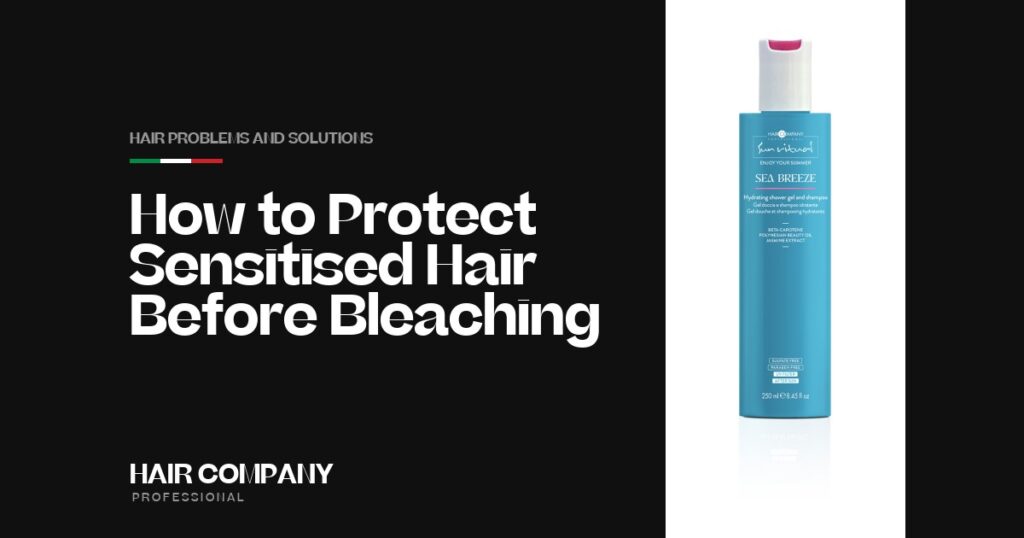
Using a non-stripping cleanser such as SEA BREEZE HYDRATING SHOWER GEL AND SHAMPOO 250ML (£13.60) is an exceptional way to purify the canvas. Formulated as a multipurpose hair and scalp cleanser, it effectively eliminates chlorine, sea salt, and residual impurities without depleting the hair’s natural hydration. Enriched with Beta Carotene, Polynesian Beauty Oil, and Jasmine Extract, it offers immediate antioxidant protection, neutralising free radicals that could otherwise compromise the integrity of sensitised strands during lightening.
Step 2: Rebuilding the Internal Architecture (Pre-Treatment Repair)
You cannot build a house on weak foundations, and you cannot safely bleach structurally compromised hair without first replenishing its protein and lipid reserves. In the one to two weeks leading up to a lightening appointment, the primary goal is to introduce hydrolysed proteins, amino acids, and biomimetic lipids deep into the cortex.
The Role of Keratin and Stem Cells
Sensitised hair suffers from voids in its keratin matrix. Incorporating advanced reconstructive treatments helps fill these micro-fractures, giving the lightener a sturdier framework to act upon.
An indispensable product for this preparatory phase is the HAIR REPAIR RECONSTRUCTION MOUSSE 200ML (£23.38). This intensive leave-in restorative formula combines Alpha Stem Complex (plant stem cells) with hydrolysed Keratin, Ceramides, Panthenol, and Jojoba Oil.
#### Why It Works:
– Keratin & Ceramides: Rebuild the damaged internal structure, reinforcing tensile strength and preventing breakage under chemical stress.
– Alpha Stem Complex: Delivers potent antioxidant defence to preserve cellular integrity.
– Panthenol & Jojoba Oil: Replenish lost moisture and restore flexibility to brittle strands.
How to Use Before Lightening: Apply the mousse through towel-dried mid-lengths and ends after cleansing, distribute with a wide-tooth comb, and blow-dry without rinsing. Using this formula in the weeks leading up to bleaching significantly improves elasticity.
Step 3: Environmental Shielding Leading Up to the Appointment
Clients planning to undergo a lightening service must protect their hair from external oxidation between salon visits. UV radiation, pollution, and chlorinated water degrade the hair’s keratin structure, leaving it more vulnerable to bleach damage.
To maintain optimal fibre resistance, daily environmental defence is essential. The SEA BREEZE PROTECTIVE FLUID 150ML (£21.25) acts as an invisible shield against solar radiation, saltwater, and environmental stressors.
Enriched with precious Argan Oil, Linseed Oil, Seaweed Extract, and Beta Carotene, this lightweight fluid seals the external cuticle, locks in essential hydration, and defends against oxidative degradation. Encouraging clients to use this fluid daily prior to their bleaching appointment ensures the hair arrives at the salon in its healthiest possible state.
Step 4: The Immediate Pre-Bleach Barrier (Day of Service)
The most crucial step in preventing catastrophic bleach damage on sensitised hair happens directly at the stylist’s chair before mixing the lightener.
Sensitised hair absorbs bleach at an accelerated, irregular rate. This creates chemical “hotspots” where damaged areas over-process before healthier roots or mid-lengths have lifted adequately. To resolve this, colourists must apply an equalising pre-treatment protector.
Porosity Equalisation with Inimitable Tech
The PRE TREATMENT PROTECTOR SPRAY 150ML (£23.99) is specifically engineered for professional use on sensitised, porous hair ahead of technical services.
This advanced formula performs several critical functions:
– Creates an Active Protective Film: Shields the most fragile parts of the hair fibre without impeding the lift of the bleaching powder.
– Vegplex & Vibrariche Technology: Reinforces the internal peptide bonds, preserving the hair’s structural integrity throughout oxidative lifting.
– Aloe Vera Conditioning: Calms the fibre, locking in moisture and delivering luminous shine to the finished result.
How to Apply the Pre-Treatment Spray Correctly:
1. Section the dry, unwashed hair where bleaching or lightening will take place.
2. Mist the PRE TREATMENT PROTECTOR SPRAY 150ML (£23.99) evenly across sensitised zones, particularly porous mid-lengths and ends.
3. Comb through to ensure complete, uniform distribution.
4. Crucial Step: Blow-dry the product completely into the hair before applying your lightener. Applying bleach directly onto wet or damp pre-treatment will dilute the developer and alter lift predictability.
Professional Bleaching Protocols for Sensitised Hair
Once the hair has been fortified with the correct pre-treatments, colourists must adjust their lightening strategy to minimise further chemical stress:
1. Choose Lower Developer Volumes
Never attempt to rush the lifting process on sensitised hair using high-volume developers (30 or 40 vol). A gradual lift using 10 vol (3%) or 20 vol (6%) developer preserves the hair lipid matrix while achieving the required level of lift cleanly and evenly.
2. Formulate with High-Performance Italian Lighteners
Select bleaching powders formulated with integrated bond protectors, conditioning oils, and anti-yellow micro-pigments. Premium Italian formulations focus on cosmetic elegance, lifting gently while respecting the scalp and hair fibre.
3. Maintain Precise Zone Application
Avoid overlapping lightener onto previously bleached, sensitised areas. When lifting regrowth, apply strictly to the root area. If the ends require cleansing or toning, use low-alkaline or demi-permanent glosses rather than standard bleach mixtures.
Post-Bleach Care: Maintaining Integrity
Preparation does not end when the bleach is rinsed. Once the desired lift is achieved, an acidifying routine is essential to close the cuticle, restore the natural pH balance (4.5–5.5), and lock in moisture.
– Rinse thoroughly with lukewarm water until every trace of lightener is eliminated.
– Cleanse gently with a post-technical or balancing shampoo.
– Re-apply a protein-and-moisture restorative treatment, such as HAIR REPAIR RECONSTRUCTION MOUSSE 200ML (£23.38), to replenish the hair after processing.
– Provide clients with clear aftercare advice: advise against high heat styling for at least 72 hours and recommend professional home maintenance products.
Summary Checklist: Protecting Sensitised Hair
| Timeframe | Action | Recommended Product |
| :— | :— | :— |
| 2 Weeks Prior | Gentle detoxifying cleanse to eliminate chlorine & minerals | SEA BREEZE HYDRATING SHOWER GEL AND SHAMPOO 250ML (£13.60) |
| 1–2 Weeks Prior | Reconstruct structural bonds and restore cortex elasticity | HAIR REPAIR RECONSTRUCTION MOUSSE 200ML (£23.38) |
| Daily Prior | Protect from UV and environmental oxidation | SEA BREEZE PROTECTIVE FLUID 150ML (£21.25) |
| Day of Bleaching | Equalise porosity and create a protective barrier | PRE TREATMENT PROTECTOR SPRAY 150ML (£23.99) |
Final Thoughts
Bleaching sensitised hair does not have to result in damage or compromise. By adopting a structured pre-treatment routine that pairs bond reinforcement, porosity equalisation, and environmental protection, colourists can deliver luminous, healthy blonde results with complete confidence.
Explore the full range of professional Italian haircare solutions at Hair Company UK to elevate your technical services and protect your clients’ hair at every step of the colouring journey.
Frequently Asked Questions
Quick Navigation:
- Can you bleach hair that is already damaged or sensitised?
- How far in advance should I start preparing sensitised hair for bleaching?
- Why must pre-treatment spray be dried completely before applying lightener?
- What developer volume should be used when bleaching sensitised hair?
- How does environmental damage affect bleaching outcomes?
- What is the difference between hair elasticity and porosity?