

The salon backwash is far more than a practical station for rinsing out bleach or washing away excess product. In modern hairdressing, it represents the emotional heart of the client journey. It is the precise moment where clinical technicality gives way to pure sensory relaxation, setting the standard for the entire appointment.
Whether you are an experienced salon owner refining your team’s protocols or a dedicated stylist striving for perfection, mastering a professional backwash routine is one of the most effective ways to boost client retention, elevate treatment ticket averages, and deliver exceptional results.
In this comprehensive guide, we explore how to curate a seamless, luxury backwash ritual using professional salon practices and high-performance Italian formulations.
Why the Salon Backwash Routine Defines Client Retention
A client might appreciate a sharp precision cut or an expertly blended balayage, but the memory they carry with them—and rave about to friends—is almost always the experience at the basin.
A world-class backwash service delivers three vital commercial advantages:
* Elevates Perceived Value: A rushed, uncomfortable wash devalues high-end colour work. A dedicated, relaxing ritual justifies premium service pricing.
* Diagnoses Hair & Scalp Health: The basin provides the clearest view of the scalp’s condition and the hair’s wet elasticity, allowing for accurate in-salon treatments and home-care recommendations.
* Builds Sensory Loyalty: Physical touch, warm water, relaxing aromas, and an ergonomic setup trigger relaxation, converting first-time visitors into lifelong salon advocates.
Step 1: Client Comfort, Hygiene, and Setup
The backwash experience begins before the water even runs. True luxury is rooted in meticulous hygiene and client comfort.
Ergonomic Positioning and Neck Support
Always take a moment to adjust the chair and basin height to suit your client’s posture. Ensure their neck rests comfortably on a cushioned silicone neck rest. A client who is straining their neck muscles cannot relax, no matter how good your scalp massage feels.
Single-Use Hygiene Protocols
Hygiene standards set elite salons apart. Shield the client’s clothing from water droplets, chemical residues, or colour bleed by draping them appropriately. Using high-quality Disposable Capes ensures single-use, hygienic protection during colour and chemical services, providing peace of mind while protecting expensive garments.
Step 2: The Consultation & Water Temperature Calibration
Never assume that every hair type requires the same washing protocol. A brief, 30-second tactile assessment at the basin informs your product selection.
Calibrating the Water
Test the water temperature on your inner wrist before directing the stream onto the client’s scalp.
* Lukewarm to Warm (approx. 37°C–38°C): Ideal for opening the hair cuticle slightly, emulsifying sebum, and dissolving product build-up without irritating the scalp.
* Never use scalding water: Excessive heat strips natural lipids, triggers scalp redness, and accelerates the fade of freshly deposited oxidative colour.
Always communicate with your client: “Is the water temperature comfortable for you?” This simple question establishes care and attentiveness immediately.
Step 3: The First Cleanse – Clarifying & Purifying
The initial wash is designed to break down environmental pollutants, sebum, silicone build-up, and chemical residues.
Thoroughly saturate the hair from roots to ends for at least 60 seconds before applying shampoo. Rushing this stage prevents the surfactants from distributing evenly.
Cleansing Build-up and Post-Sun Residue
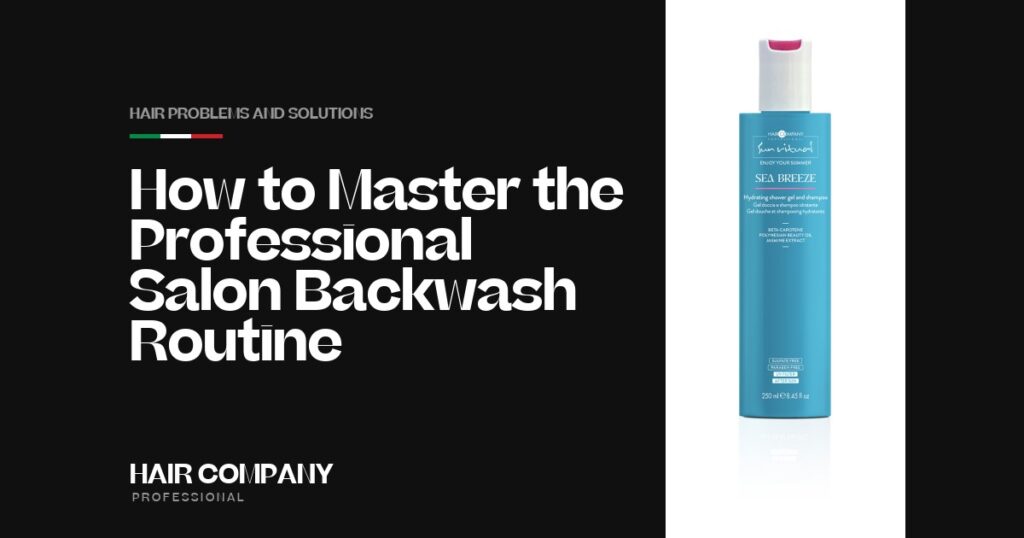
For clients returning from holiday, swimmers, or those with notable product accumulation, a targeted purifying formula is essential. Using SEA BREEZE HYDRATING SHOWER GEL AND SHAMPOO 250ML (£13.60) provides an ideal 2-in-1 clarifying solution. Its formulation with Beta Carotene, Polynesian Beauty Oil, and Jasmine Extract actively eliminates chlorine, salt, and atmospheric impurities while repairing sun-stressed hair fibres without dehydrating the scalp.
Proper Application Technique
1. Emulsify a 10p-to-50p coin-sized amount of shampoo between your palms.
2. Distribute evenly across the five main anchor zones: hairline, crown, temples, occipital bone, and nape.
3. Work using the pads of your fingers in circular motions—never use your fingernails.
4. Rinse thoroughly with warm water, lifting the hair to ensure no suds remain trapped at the nape.
Step 4: The Second Cleanse – Targeted Scalp Care and Balance
The second cleanse treats the specific biological needs of the scalp and strand. Because the initial layer of grime has been removed, the active ingredients in your professional shampoo can penetrate effectively.
Treating the Scalp-Hair Ecosystem
Healthy hair growth is impossible without a balanced scalp microbiome. If your client exhibits sensitivity, excess sebum, flaking, or structural brittleness from chemical over-processing, introduce a dual-action system.
Integrating the Double Action Set – Scalp Balance & Hair Repair (£129.99) allows you to re-establish physiological equilibrium at the root while depositing restructuring compounds along the hair shaft. This dual approach purifies congested follicles while strengthening weakened keratin bonds, making it an indispensable backwash treatment for compromised hair.
Step 5: Deep Conditioning & The Signature Scalp Massage
The conditioning and treatment phase is where ordinary washing transforms into a signature salon ritual. This step should never be rushed.
Applying Intensive Treatments
Gently squeeze excess moisture from the hair before applying your mask or conditioner; hair saturated with water cannot absorb active conditioning agents. Apply the treatment mid-lengths to ends, using a wide-tooth comb or your fingers to ensure uniform distribution.
For comprehensive salon restorative care, the Hair Care Professional Routine (£129.99) delivers a complete system designed to nourish, repair, and smooth stressed cuticles. Formulated to professional Italian manufacturing standards, it infuses the cortex with moisture, seals the outer layer, and imparts mirror-like shine.
“
                    ┌───────────────────────────────┐

                    │     1. Effleurage (Gliding)   │

                    │   Connects & relaxes tension  │

                    └───────────────┬───────────────┘

                                    │

                                    ▼

                    ┌───────────────────────────────┐

                    │     2. Petrissage (Kneading)  │

                    │  Stimulates scalp circulation │

                    └───────────────┬───────────────┘

                                    │

                                    ▼

                    ┌───────────────────────────────┐

                    │     3. Friction (Vibration)   │

                    │ Releases occipital/nape stress│

                    └───────────────┬───────────────┘

                                    │

                                    ▼

                    ┌───────────────────────────────┐

                    │     4. Treading Rinsing       │

                    │  Clean finish with cool seal  │

                    └───────────────────────────────┘
The 3-Step Professional Scalp Massage Technique
1. Effleurage (Soothing Strokes): Place both hands under the nape, lifting gently towards the crown in slow, rhythmic gliding motions. This distributes product while relaxing the central nervous system.
2. Petrissage (Circular Kneading): Using the pads of your thumbs and fingers, apply firm, deliberate circular pressure around the base of the skull, moving upward across the parietal ridges to the crown. Keep movements slow and rhythmic.
3. Friction and Pressure Points: Gently press your thumbs into the occipital hollows at the base of the skull for three seconds, release slowly, and sweep across the temples.
Pro Tip: Maintain continuous physical contact. Lifting your hands abruptly breaks the sensory immersion.
Step 6: The Rinsing Protocol & The Cool Seal
Thorough rinsing is just as critical as product application. Residual conditioner left at the scalp weighs down the root area, attracts dirt, and leads to dull, lifeless styling results.
- Support the Nape: Use one hand to lift and support the client’s head, ensuring the water flow reaches the underside of the hair at the neck, which is often missed.
- The Cool Water Seal: Conclude the rinse with a slightly cooler water temperature for 15–20 seconds. This constricts the cuticle layer, locks in the conditioning actives, enhances natural light reflection, and invigorates the scalp.
Step 7: Towel Drying and Transition to the Styling Chair
The transition from the basin to the styling station must be seamless and comfortable.
1. Gently Squeeze, Never Rub: Vigorously rubbing wet hair with a towel roughs up the cuticle layer, causes mechanical breakage, and induces unwanted frizz. Blot and press the hair firmly to absorb excess moisture.
2. The Professional Turban Wrap: Secure the hair smoothly in a clean, soft towel, ensuring no stray wet strands drip onto the client’s face or collar.
3. Assisted Rise: Offer a steady hand or prompt the client gently as they sit up, preventing light-headedness after a long, relaxing reclined service.
Practical Backwash Protocols: Quick Reference Guide
| Step | Action | Key Objective | Recommended Product / Tool |
| :— | :— | :— | :— |
| 1. Preparation | Adjust basin & neck support | Client comfort & clothing protection | Disposable Capes |
| 2. First Cleanse | 60s rinse, apply clarifying wash | Remove environmental grime, chlorine & build-up | SEA BREEZE HYDRATING SHOWER GEL AND SHAMPOO 250ML (£13.60) |
| 3. Second Cleanse | Target scalp & follicle health | Rebalance microbiome & strengthen roots | Double Action Set – Scalp Balance & Hair Repair (£129.99) |
| 4. Deep Treatment | Apply mask & perform scalp massage | Cuticle sealing, hydration & deep relaxation | Hair Care Professional Routine (£129.99) |
| 5. Finishing | Cool rinse & gentle towel blot | Close cuticle, lock in shine & avoid frizz | Microfibre towel / Salon cotton |
Elevating the Salon Environment: The Sensory Details
To turn your backwash into an unforgettable sanctuary, consider the ambient environment:
- Lighting: Avoid direct spotlights overhead. Opt for soft, dimmable, or indirect warm lighting over the basins to allow clients to close their eyes without glare.
- Acoustics: Position your backwash away from loud reception areas or noisy blow-dry stations where possible. Soft, ambient background music helps create a spa-like retreat.
- Retail Opportunities: The backwash is where retail sales naturally originate. When clients feel the tactile difference of high-grade Italian professional formulas and smell exquisite extracts like Jasmine and Polynesian oils, they will naturally ask: “What did you use on my hair today?”*
By structuring your backwash routine around scientific care, ergonomic comfort, and sensory indulgence, you turn a routine step into an indispensable salon signature.
Frequently Asked Questions
Quick Navigation:
- How long should a professional salon backwash routine take?
- Why should stylists always perform two shampoos at the backwash?
- What is the ideal water temperature for washing hair in a salon?
- How can salons prevent water dripping onto clients' clothing at the basin?
- How do you choose the right backwash treatment for chemically treated hair?
- How can stylists convert the backwash experience into retail sales?