

Fine hair that has suffered chemical, thermal, or environmental damage presents one of the most delicate challenges in professional hairdressing. When fine strands become compromised, they lose structural protein, shed their protective lipid layer, and flatten against the scalp. Traditional volumising products often dry out fragile fibres, while standard deep-conditioning treatments frequently overload fine strands, leaving them limp, greasy, and lifeless.
To successfully make fine damaged hair look thicker and fuller, you must approach hair care with a dual strategy: structural internal repair and lightweight external body-building. By replenishing essential proteins and moisture without introducing heavy residues, you can restore density, bounce, and resilience to vulnerable hair.
Understanding Fine vs Damaged Hair: The Structural Dilemma
Before addressing the solution, it is vital to distinguish between hair diameter and hair health.
- Fine Hair: Refers strictly to the diameter of each individual strand. Fine hair has a smaller cortex and a thinner cuticle layer (often only 4 to 8 cuticle layers compared to 10 to 12 in coarse hair). It naturally lacks the internal rigidity required to hold volume.
- Damaged Hair: Refers to structural degradation. Chemical processing (bleaching, colouring, perming), thermal styling, and UV radiation break the disulphide bonds and deplete keratin within the cortex, leaving the cuticle lifted, jagged, and porous.
When fine hair becomes damaged, the hollowed-out cortex collapses easily. The lifted cuticle creates friction, leading to severe tangling, breakage, and split ends that make the hair look even thinner towards the perimeter. The objective is to reconstruct the hair’s architecture from within, sealing the cuticle flush to reflect light and create tangible, weightless density.
Step 1: Clarify and Cleanse with Precision
Building fullness begins at the basin. Product buildup, natural sebum, and environmental impurities weigh fine strands down at the root, making any attempt at styling futile. However, harsh, stripping shampoos will only exacerbate cuticle damage.
“
+-------------------------------------------------------------+

|               THE DUAL CLEANSING STRATEGY                   |

+------------------------------+------------------------------+

|       STRUCTURAL REPAIR      |     ENVIRONMENTAL DETOX      |

|  Targets: Chemical/Heat      |  Targets: Sun/Salt/Chlorine  |

|  Active: Biomimetic Keratin  |  Active: Beta Carotene       |

+------------------------------+------------------------------+
Targeted Keratin Cleansing for Compromised Strands
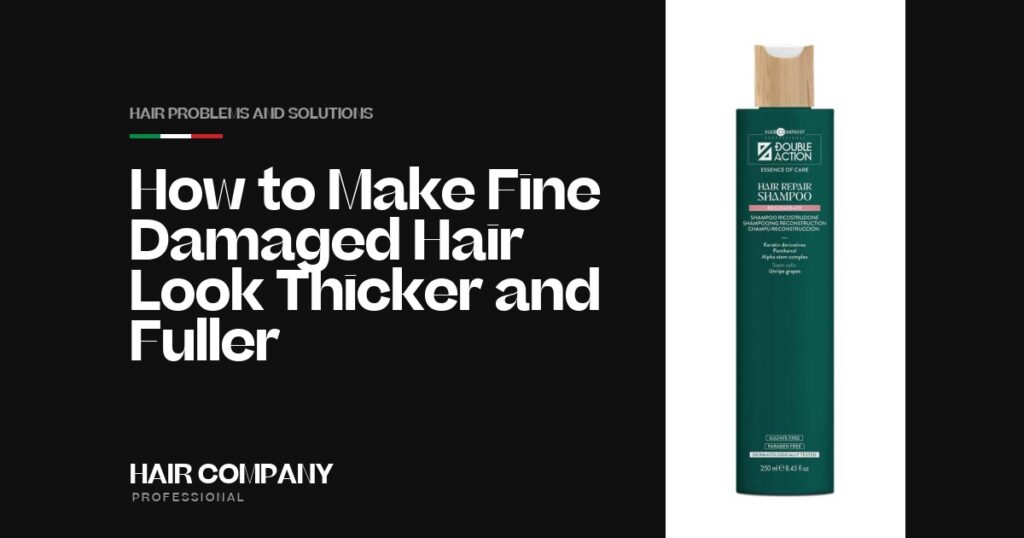
For everyday structural recovery, select a cleanser that targets damaged areas selectively rather than coating the entire strand in heavy polymers. The HAIR REPAIR SHAMPOO 250ML (£12.99) delivers specialised care using hydrolysed biomimetic keratin. Unlike indiscriminate conditioning agents, biomimetic keratin attaches specifically to areas with an amino acid imbalance. It strengthens the weakened cortex without leaving unneeded residue on healthy sections, ensuring fine strands remain feather-light and naturally lifted.
Removing Environmental Weight and Chemical Residues
If fine hair is exposed to outdoor elements, swimming pools, or hard water, mineral deposits and salt crystals will sap moisture and flatten the root. The SEA BREEZE HYDRATING SHOWER GEL AND SHAMPOO 250ML (£13.6) acts as an exceptional detoxifying cleanser. Formulated with antioxidant-rich Beta Carotene, Polynesian Beauty Oil, and Jasmine Extract, this multi-action cleanser effectively removes chlorine and salt residues while repairing sun-stressed fibres, leaving the scalp refreshed and the hair shaft weightlessly polished.
Step 2: Reconstruct the Internal Cortex Without Adding Weight
The most common mistake clients and stylists make with fine, damaged hair is applying rich, buttery masks loaded with heavy silicones and mineral oils. These ingredients coat the exterior, creating an illusion of smoothness for a few hours before causing the hair to collapse under the sheer physical weight of the product.
`
Traditional Heavy Masks:

[Heavy Silicones/Oils] ---> Coats exterior ---> Adds excessive weight ---> Hair collapses flat
Intelligent Cellular Repair:
[Ceramides + Stem Cells] ---> Penetrates cortex ---> Restores internal strength ---> Hair remains buoyant
`
To create lasting fullness, structural repair must happen at the cellular level. The HAIR REPAIR MASK 250ML (£19.55) is engineered specifically for fine, fragile hair that requires deep structural restoration.
Why the Active Formulation Works:
- Alpha Stem Complex & Unripe Grape Stem Cells: Provide potent antioxidant defence, protecting vulnerable cuticles from oxidative stress.
- Hydrolysed Keratin: Fills the micro-fractures in the hair cortex, physically increasing the internal diameter of each strand.
- Ceramide A2: Replaces the lipid cement between the cuticle scales, smoothing the surface and locking in moisture without flattening the root.
- Panthenol (Vitamin B5) & Jojoba Oil: Deliver balanced hydration, enhancing strand elasticity and preventing snapping during styling.
Application Tip: Apply a 10p-sized amount exclusively from the mid-lengths to the ends after shampooing. Gently comb through with a wide-tooth comb to distribute evenly, leave for 3 to 5 minutes, and rinse thoroughly with cool water to seal the cuticle flat.
Step 3: Choose Leave-In Reinforcement Over Heavy Creams
Leave-in conditioners are essential for protecting damaged hair against heat and mechanical friction, but standard leave-in lotions are often too dense for fine hair.
Foam and mousse delivery systems are the professional standard for fine textures because the airy micro-bubbles distribute active ingredients evenly across the hair shaft without pooling or creating greasy spots.
The HAIR REPAIR RECONSTRUCTION MOUSSE 200ML (£23.38) is an indispensable leave-in treatment for fine, damaged hair. Formulated with Keratin, Ceramide A2, and the Alpha Stem Complex, this leave-in mousse strengthens the internal fibre while providing instant structural hold.
Benefits of Reconstruction Mousse:
1. Elasticity Restoration: Jojoba oil and Panthenol infuse hydration, allowing the hair to stretch and recover rather than break under tension.
2. Thermal Shielding: Forms a microscopic protective shield around the cuticle, preventing heat appliances from vaporising internal moisture.
3. Natural Fullness: Gives the hair tangible body, root lift, and texture that lasts throughout the day without stickiness or stiffness.
To use, dispense one or two golf-ball-sized amounts into palms, work through damp, towel-dried hair from roots to ends, and proceed directly to blow-drying.
Step 4: Professional Blow-Drying and Styling Techniques
How you mechanically dry and style fine, damaged hair dictates how thick it will appear. Follow these professional salon steps:
`
[1. Rough Dry to 80%] ---> [2. Over-Direction at Roots] ---> [3. Ceramic Round Brush] ---> [4. Cool-Shot Setting]

(Low-to-medium heat)       (Lift upward & outward)           (Smooth mid-lengths)           (Lock structural volume)
1. The 80% Rough-Dry Rule
Never apply high tension or a round brush to sopping wet, damaged hair. Hair is weakest when wet due to hydrogen bonds being broken. Use your fingers and a blow-dryer on medium heat to gently rough-dry the hair until it is roughly 80% dry.
2. Directional Root Lifting
To maximise vertical volume at the scalp:
* Flip the head upside down while drying the roots, or
* Use a vent brush to over-direct the hair across the crown in the opposite direction of its natural growth pattern.
3. Tension and Brush Selection
Once the hair is 80% dry, section it into small horizontal rows. Use a medium ceramic or tourmaline round brush. Ceramic barrels retain heat evenly, smoothing the damaged cuticle quickly and reducing the amount of time hair spends exposed to direct airflow. Keep the nozzle pointed down the hair shaft to flatten the cuticle scales, which creates high shine and eliminates the fuzzy appearance of damaged ends.
4. Lock with the Cool-Shot Button
Keratin softens when heated and hardens when cooled. Once a section is wrapped around the round brush and warmed, blast it with the blow-dryer’s cool-shot setting for 5 to 10 seconds. This sets the structural shape and locks in root volume.
Step 5: Strategic Haircuts and Colour Placement
Visual density can be created using clever cutting and colouring techniques tailored for fine, damaged hair.
The Power of Blunt Perimeters
While heavy layering can remove necessary weight from thick hair, it can make fine hair look sparse, stringy, and fragile at the ends. Opt for:
* Blunt Bobs and Lob Cuts: A sharp, one-length perimeter creates a solid baseline that makes the bottom edge of the hair look remarkably dense.
* Internal Ghost Layers: Very subtle, internal micro-layers give movement and texture without sacrificing the perimeter baseline.
Dimensional Colouring
Flat, monochromatic colour makes fine hair appear one-dimensional and thin.
* Shadow Roots: A root colour that is half a shade to one shade deeper than the mid-lengths creates an optical illusion of depth and thickness at the scalp.
* Micro-Balayage and Babylights: Fine, multi-tonal highlights add dimension, making the hair reflect light in varying directions to simulate thickness.
Daily Maintenance: Protecting Fragile Density
To keep fine, damaged hair looking full day after day, minimise mechanical friction and thermal stress:
- Sleep on Silk: Swap cotton pillowcases for 100% mulberry silk to prevent nightly friction, cuticle fraying, and split ends.
- Avoid Tight Hairbands: Use soft silk or velvet scrunchies instead of traditional elastic ties, which cause focal breakage around the crown.
- Limit Hot Tool Usage: Keep styling irons below 180°C. High heat degrades the hair’s natural keratin, making fine strands progressively thinner over time.
By combining intelligent biomimetic cleansing with HAIR REPAIR SHAMPOO 250ML (£12.99), deep cellular nourishment with HAIR REPAIR MASK 250ML (£19.55), and weightless volume styling with HAIR REPAIR RECONSTRUCTION MOUSSE 200ML (£23.38), you can rebuild damaged hair fibres from within to achieve lasting, natural fullness.
Frequently Asked Questions
Quick Navigation:
- Can fine damaged hair ever become permanently thicker in diameter?
- Why do traditional volumising shampoos make damaged hair feel dry and brittle?
- How often should I use a hair repair mask on fine damaged hair?
- Is a leave-in mousse better than a cream or serum for fine damaged hair?
- Does bleaching always make fine hair look thinner?
- What is the best blow-drying temperature for fine damaged hair?