

In the modern salon, time is both your most valuable asset and your biggest challenge. Every colourist knows the tension between maintaining a profitable, punctual column and delivering flawless, opaque grey coverage. When a client sits in your chair with dense, resistant regrowth, the temptation to rush can be overwhelming. Yet, cutting corners with development times or rushing application invariably leads to patchy results, translucent roots, and disappointed clients.
The secret to working more efficiently does not lie in pulling the colour off five minutes early. True efficiency comes from intelligent formulation, superior colour chemistry, refined sectioning, and structured salon workflows.
Here is how you can achieve 100% grey hair coverage faster while maintaining the uncompromising standards of Italian professional hair artistry.
Short answer: Grey coverage gets faster when the formula is right, not when the timer is cheated. On Inimitable Color Classic, resistant grey needs 20 Vol at 1:1.5 for a full 35 minutes, and pushing to 30 Vol buys lift, not coverage. If the client is short of time, the honest shortcut is a different product rather than a shorter clock: the 10-minute cream reaches full coverage in ten minutes at 1:1 on 20 Vol. For stubborn grey above 75 percent, mix two parts of the Natural shade with one part of the fashion shade, because the Natural series carries the pigment load that covers. Below 75 percent grey, one to one is enough. Apply to the most resistant zone first, usually the hairline and the crown, and re-check halfway through so the product has not dried out on those finer, more resistant strands.
These are the manufacturer’s own figures for the Classic line and for grey-resistant mixing:
| Result you want | Developer | Time | Ratio |
|---|---|---|---|
| Toning and neutralising | 5 to 10 Vol (1.5 to 3%) | On sight | 1:1 to 1:1.5 |
| Grey coverage, lift 1 to 2 levels | 20 Vol (6%) | 35 min | 1:1.5 |
| Grey coverage, lift 2 to 3 levels | 30 Vol (9%) | 40 min | 1:1.5 |
| Super-lighteners only | 40 Vol (12%) | 45 min | 1:2 |
| Hair texture | Grey percentage | What to mix | Developer |
|---|---|---|---|
| Fine to medium | Over 75% | 2 parts Natural shade + 1 part fashion shade | 20 Vol |
| Fine to medium | Under 75% | 1 part Natural + 1 part fashion shade | 20 Vol |
The Science of Resistant Grey Hair: Why It Takes Time
To speed up your grey coverage services safely, you must first understand what makes silver strands so notoriously resistant.
When hair loses its natural pigmentation, it does not simply lose colour; its physical architecture changes:
* Compacted Cuticle Layers: Grey hair often features a tightly bound, hardened cuticle layer that acts as a fortress against colour penetration.
* Loss of Natural Lipids: As melanocytes shut down, the hair produces fewer natural oils, leaving the strand drier, coarser, and less naturally receptive to moisture and oxidation.
* Absence of Underlying Pigment: Because there is no natural melanin (eumelanin or pheomelanin) to build upon, your artificial colour must provide both the depth and the tonal nuance simultaneously.
If you attempt to speed up the process by using overly aggressive developers or reducing oxidation time, the colour molecules will not develop deeply within the cortex. The result? A hollow, translucent finish that fades rapidly within two weeks.
1. Master Precision Formulation: Stop Wasting Processing Time
The fastest way to achieve full coverage is to formulate accurately the first time. Re-application and corrective toning add unwanted minutes to your salon schedule.
Balance Natural Base with Reflect Shades
Never apply a purely fashion or tonal shade to hair that is more than 30% grey without supporting it with a natural base. As a golden rule:
* 30% to 50% Grey: Mix 1/3 Natural Base (.0) with 2/3 Target Shade.
* 50% to 100% Grey: Mix 1/2 Natural Base (.0) with 1/2 Target Shade.
* Extremely Coarse/Resistant Hair: Increase the Natural Base to 2/3 and use a 1:1 mixing ratio rather than 1:1.5 to intensify pigment density.
Choose High-Lustre, Micro-Pigment Formulations
Traditional high-ammonia colours blast the cuticle open, causing surface damage that leads to rapid colour slip. Modern Italian formulations utilise refined micro-pigments that slip effortlessly between cuticle scales without requiring excessive chemical force.
For classic full-head and root applications, professional colourists turn to COLOURING CREAM CLASSIC (£9.49). Engineered with low ammonia for a gentler, more comfortable service, this permanent oxidation colour achieves 100% grey hair coverage while infusing the cortex with Silk Extract, Pearl, Amber, and Amethyst. Because the pigments are exceptionally concentrated, you achieve full opacity without needing prolonged, unnatural development cycles.
2. Streamline Your Application Technique
Speed at the chair is rarely about moving your hands furiously; it is about eliminating wasted movement and ensuring complete saturation on the first pass.
Work in Fine, Translucent Slices
The single biggest cause of resistant grey patches is thick sectioning. Applying colour to large subsections starves the middle strands of product and oxygen.
* Take razor-thin, 0.5 cm partings. You should be able to read newsprint through the hair section.
* Lay the product onto the hair rather than scraping it flat. Grey hair must be bathed in colour cream for the oxidation reaction to take place evenly.
Strategic Zone Application
Do not start your application randomly. Begin precisely where the hair is most resistant:
1. The Crown and Parting: Apply to the client’s visible parting line and high-density grey areas first, giving these stubborn zones the maximum possible development time.
2. The Temples and Hairline: Grey hair at the hairline is often finer yet more resistant. Outline the front hairline with a generous bead of colour.
3. The Back and Nape: Finish with the occipital and nape areas, which typically contain a lower percentage of white hair and process more readily.
3. Fast-Track Services for Men and Express Clients
Not every client wants or needs a traditional 45-minute permanent colour application. Male clients and express-service bookings often require a natural blend that softens grey hair in a fraction of the time.
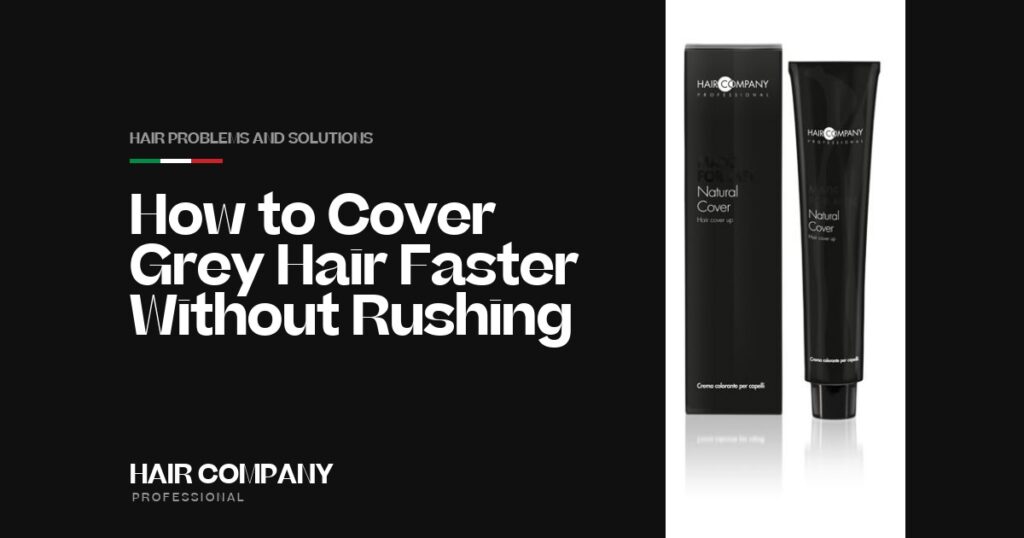
For these appointments, reach for NATURAL COVER COLOURING CREAM FOR MEN (£5.99). This dedicated permanent oxidation colour is designed for variable processing:
* Brushed Effect (5–10 Minutes): Softens the contrast between salt-and-pepper tones for an undetectable, youth-restoring blend that adds zero stress to your salon timetable.
* Full Coverage (15–20 Minutes): Provides natural-looking, non-progressive opacity without unwanted warm or brassy undertones.
By introducing dedicated express grey services, you can reduce standard appointment times from 60 minutes down to 30 minutes, freeing up valuable chair time while expanding your service menu.
4. Equip Your Dispensary for Maximum Workflow Speed
A disorganised dispensary causes hidden delays that disrupt your entire working day. Searching for shades, rummaging for developers, and mixing with inadequate tools wastes precious minutes before you even touch the client’s hair.
Upgrading your dispensary setup with a structured system like the Colouring Starter Kit – Professional Colour System (£129.99) ensures your salon runs like clockwork. Having an all-inclusive, organised suite of professional colours, developers, and accessories at your fingertips eliminates guesswork, standardises measurements, and allows you to mix formulas accurately in seconds.
Consistency in your tools creates consistency in your timings.
5. Lock in Colour Immediately to Prevent Premature Fading
A fast, successful grey coverage service does not conclude at the washbasin; it extends to cuticle sealing. If the hair is not properly neutralised and closed post-colour, the client will experience premature fade, resulting in early regrowth complaints that disrupt your regular maintenance schedules.
Complete your service with the Hair Care Professional Routine (£129.99). This professional backwash and home-care system re-establishes optimal hair pH, balances moisture levels, and locks the cuticle tightly over the newly deposited micro-pigments. Sealing the surface ensures the rich lustre of the colour remains vibrant until the client’s next scheduled touch-up.
Summary: The Formula for Faster Grey Coverage
Covering grey hair faster is not about rushing your timer—it is about refining your process from start to finish.
1. Analyse: Assess grey percentage and choose the correct base ratio immediately.
2. Formulate: Use micro-pigment creams like COLOURING CREAM CLASSIC (£9.49) for instant, reliable saturation.
3. Target: Apply first to resistant zones using fine 0.5 cm slices.
4. Offer Express Options: Use NATURAL COVER COLOURING CREAM FOR MEN (£5.99) for quick-turnaround male grooming.
5. Protect: Preserve the integrity and longevity of the colour using the Hair Care Professional Routine (£129.99).
By combining superior Italian colour technology with disciplined application habits, you elevate your artistry, delight your clients, and keep your salon schedule running with effortless precision.
Frequently Asked Questions
Quick Navigation:
- Can I use heat to make grey hair colour process faster?
- Why does grey hair colour look translucent even after the full processing time?
- What developer volume is best for quick and complete grey coverage?
- How can I speed up grey coverage for male clients who hate sitting in the salon?
- How does a low-ammonia colour achieve 100% grey coverage?
- What should I do if the hairline greys refuse to hold colour?