

Fine hair is notoriously delicate, easily weighed down, and prone to falling flat within hours of styling. For professional hairdressers and discerning clients alike, generating touchable body and movement in fine salon hair requires more than a standard round-brush blow-dry. It demands a holistic strategy that combines hair architecture, precision cutting, scalp clarification, and targeted Italian professional treatments.
When fine hair lacks volume, the issue rarely lies in the quantity of hair strands alone. It is fundamentally a question of structural diameter, moisture-to-protein balance, and root tension.
Here is our comprehensive guide to transforming fine, limp hair into dynamic, fluid tresses full of natural vitality.
Understanding the Anatomy of Fine Hair
To effectively inject movement into fine tresses, one must understand its biological behaviour. Fine hair has a smaller diameter than medium or coarse hair, meaning it possesses a smaller cortex and often lacks a medulla.
Because the cortex contains the protein bonds responsible for tensile strength and elasticity, fine strands have less natural structural rigidity. Consequently:
* Fine hair absorbs sebum quickly: The scalp’s natural oils travel down narrow strands rapidly, causing them to clump together and collapse against the scalp.
* Fine hair is susceptible to product overload: Heavy silicones, occlusive oils, and generic styling butters coat the cuticle, suffocating movement.
* Fine hair lacks natural bounce: Without inner structural support, the hair cannot hold kinetic tension, making dynamic movement difficult to sustain.
To create sustainable body, your salon protocol must follow a three-tier methodology: Cleanse & Purify, Rebuild Internal Architecture, and Sculpt & Direct.
Step 1: Weightless Cleansing and Clarification
Limp hair cannot be lifted if it is weighed down by environmental build-up, hard water minerals, or styling residue. Achieving movement begins at the backwash basin with a purifying, lightweight cleanse that refreshes the scalp and frees the hair shaft from heaviness.
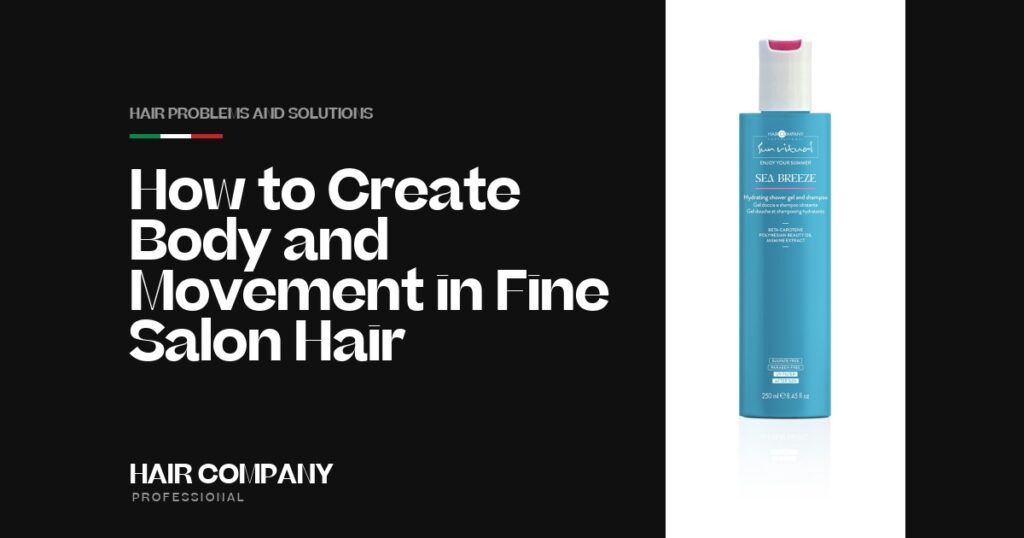
When dealing with active clients or post-holiday hair suffering from chlorine, sea salt, or product accumulation, start with a targeted clarifying and restoring formula such as SEA BREEZE HYDRATING SHOWER GEL AND SHAMPOO 250ML (£13.6).
This multifunctional Italian formulation delivers a gentle yet thorough cleanse that eliminates chlorine, salt, and residue without stripping delicate lipids. Enriched with antioxidant Beta Carotene, nourishing Polynesian Beauty Oil, and conditioning Jasmine Extract, it polishes the cuticle and infuses light moisture without creating greasy build-up. The result is an ultra-clean scalp and lightweight, breathable strands that naturally lift from the root.
Step 2: Reinforcing Internal Strength and Elasticity
The most common mistake stylists make with fine hair is applying traditional conditioning masks that over-soften the hair fiber. Fine hair does not require heavy emollients; it requires structural reinforcement. If the inner core of the strand is fragile, no amount of thermal styling will keep the hair lifted throughout the day.
To give fine hair the internal scaffold it needs to bounce and retain shape, integrate a high-performance reconstructing treatment into the salon service.
We recommend the HAIR REPAIR LOTION A+B (new) (£42.5). This advanced two-component reconstructive system works deep within the cortex to restore damaged internal architecture:
- Active Ingredients: Powered by Keratin derivatives, Unripe Grape Stem Cells, Panthenol, and the proprietary Alpha Stem Complex.
- How It Enhances Movement: By repairing compromised keratin chains and restoring natural elasticity, the hair gains structural “snap”. Instead of flopping limply, strands actively rebound against each other, creating airy separation and continuous fluid motion.
- Application Tip: Mix components A and B in equal parts to activate the emulsion. Apply through mid-lengths and ends on shampooed, towel-dried hair. Allow it to process, then rinse thoroughly before cutting or styling.
Step 3: Precision Salon Cutting Techniques for Fine Hair
A great cut is the blueprint of movement. With fine hair, the goal is to remove internal weight while preserving perimeter density. If the perimeter is cut too thin, the hair looks wispy and sparse; if left entirely blunt without internal relief, it remains static and immobile.
1. The Solid Perimeter with Ghost Layers
Create a firm, blunt baseline to establish the illusion of thick, healthy hair. Once the baseline is established, introduce internal “ghost layers”—subtle, seamless layers cut underneath the top veil of hair. This allows the shorter interior strands to push the longer exterior strands upward, creating immediate body.
2. Deep Point-Cutting and Micro-Texturising
Avoid using thinning shears on fine hair, as they create split-like fuzz that weakens hair tips. Instead, use precision point-cutting at a 45-degree angle to create micro-variations in strand length. These subtle variations prevent strands from nesting together into flat sheets.
3. Directional Over-Direction
When cutting the crown and face-framing sections, over-direct the hair forward and upward. This technique builds a natural graduation that effortlessly falls backward with dynamic movement when dried.
Step 4: Blow-Drying and Root Architecture
Fine hair requires mechanical support during the drying phase to set the shape memory of the hydrogen bonds.
1. Prep Damp Hair: Ensure hair is gently towel-dried to remove 70% of moisture. Overly wet hair exposed to intense brush tension will stretch and lose its natural bounce.
2. Directional Pre-Drying: Flip the client’s head forward or use your fingers to lift hair directly upward away from the scalp while directing airflow at the roots.
3. Round Brush Tension & Cooling: Work in narrow sections no wider than the diameter of a medium ceramic or boar-bristle brush. Lift hair at a 90-degree angle from the scalp, apply controlled heat, roll the section, and—critically—blast with the cold shot button for 5 to 10 seconds. The cold air locks the keratin shape into place, ensuring the root lift does not drop.
Step 5: High-Precision Styling and Targeted Control
Styling products for fine hair must offer hold without flaking, greasiness, or heavy residue. While heavy waxes and dense creams flatten fine strands, precision-applied styling agents can create architectural lift at the root base or targeted definition on modern, texturised cuts.
For structured short-to-medium styles, fringe control, or dramatic root lift, use a micro-dose of EXTREME HAIR GEL (£10).
Formulated with French Oak Extract, this professional styling gel provides hydrating anti-ageing properties while delivering extreme, long-lasting hold with zero residue.
* For Short Fine Hair: Work a small amount between fingertips and disperse through dry hair for bold, expressive definition that resists humidity without flaking.
* For Root Control: Emulsify a pea-sized amount with damp hands and apply strictly at the root area prior to round-brushing. It builds a supportive foundation that holds hair upright throughout the day.
Step 6: Preserving Long-Term Vitality with a Complete Routine
Consistent results rely on consistent care. Fine salon hair exposed to regular thermal styling, environmental aggressors, and chemical treatments can quickly degrade, returning to a lifeless, flat state.
For clients dedicated to maintaining full-bodied, salon-grade bounce at home, prescribe a comprehensive care regimen such as the Hair Care Professional Routine (£129.99). Providing a synergistic, multi-step maintenance plan ensures the hair retains ideal moisture balance, scalp cleanliness, and structural resilience between salon visits.
Educating your clients on using professional-grade Italian routines ensures their fine hair remains pliable, voluminous, and receptive to salon styling every single day.
Summary: The Formula for Flawless Body and Movement
Creating incredible body and movement in fine salon hair is not about fighting against the hair’s nature—it is about understanding its physics and choosing the right formulations.
- Purify thoroughly to eliminate weight and sebum build-up.
- Reinforce the cortex with active keratin and stem-cell treatments.
- Cut strategically with internal layering to prevent flat clustering.
- Style with intention using temperature contrast and weightless hold.
By incorporating these techniques and premium Italian professional hair treatments, you can consistently unlock vibrant, touchable volume that moves naturally with every step.
Frequently Asked Questions
Quick Navigation:
- Why does fine hair lose volume so quickly after blow-drying?
- How can I tell the difference between thin hair and fine hair?
- Can deep-conditioning treatments ruin the volume in fine hair?
- What is the best cutting technique to create movement in fine hair?
- Is hair gel suitable for fine hair styling?
- How often should fine hair be clarified to maintain natural body?